Interview with Elizabeth Hershey
Recorded February, 1980, with Greg Williams and Brian Caldwell, at Elizabeth's apartment at 434 East Ross Street, Lancaster, Pennsylvania

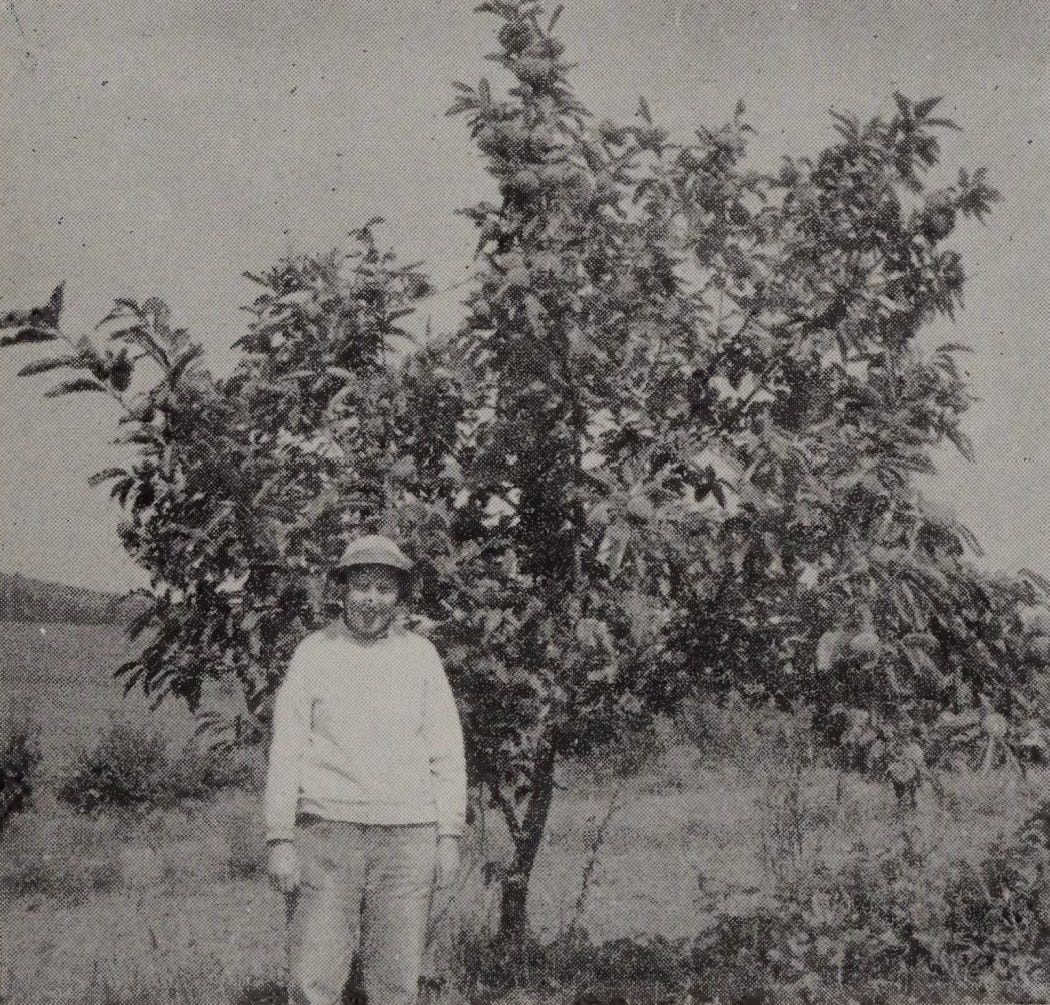
[Photo I believe to be Elizabeth “Betty” Hershey, 1901-1987, pictured in the catalog from fall ‘57-spring ‘58 of the nursery she and her husband John W. Hershey, 1898-1967, ran from 1926 until his death in ‘67.. Her picture appears in a handful of other catalog issues, too.]
A note on the transcription and editing:
This was a bear of a task! While AI transcribers exist, due to the poor quality of the original cassette tape recording, rapid-fire nature of the conversation, and need for human decisions and contextual knowledge, I ended up transcribing this all by hand. Many hours of work went into this. Where a [?] is marked, this indicates less confidence in what is being transcribed. Double dots [..] indicate where the voices trailed off into unintelligibility but were trivial in importance. Where I could not discern what was being said, when it might not have been trivial, I simply wrote [unintelligible]. Elsewhere, I have included brackets with an asterisk [*] to describe other things happening in the conversation, such as laughter or other sounds. Notes on persons or additional links/resources are in brackets [ ]. Images and supplemental writing are added where it makes sense and is relevant. If you are listening and notice something I missed, or know any missing context, please reach out!
Thanks for listening and reading. Thank you to Greg Williams and Brian Caldwell who made this recording 45 years ago with the intent that these voices from history be preserved. Thanks to Dominic Guanzon (of the Poor Prole’s Almanac) for cleaning up the audio. I have done my best to offer these recordings and their transcription to the public for posterity.
Towards the end of their interview with Elizabeth “Betty” Hershey, Greg and Brian share with her their excitement regarding the growing tree crops movement among the young people in 1980. The back-to-the-land movement had reached its maturity, the permaculture movement was burgeoning, and hope was felt in the air.
But that was 45 years ago. Somewhere along the way the tree crops idea was tossed aside again, only to resurface now it seems in recent years. We know this is true because the feeling of our present time is one of re-discovery and a rekindling of knowledge and practice that crosses the lines where continuity once faded. Given our present moment, where now agroforestry is receiving federal funding and recognition, silvopasture is being implemented at scale, and specialty cooperatives are building economic models for real-world tree crop farming, I would share in the same hopes and enthusiasms for a future full of tree crops, just as Greg and Brian did in 1980.
How the times change and how the cycles ebb and flow! It is time to let the fruit of the tree crops movement grow ripe.
Start of part one (run time 46 mins)
Elizabeth Hershey: It was more for hearing his was…
Greg Williams: I just borrowed that from his granddaughter [..] to take back and copy, ‘cause I'd never seen it before and, so she loaned it to me…….. Let me show you what I have found with regard to John’s material.
Elizabeth: Well you put your cup on the floor!
Greg: That’s alright.
Brian Caldwell: Yeah, well it’ll stay up here ‘cause it has a rock in the pocket up there.
Elizabeth: Do you want to sit over here beside me?
Brian: Ok.
Greg: I have these Annual Progress reports that John put out for many years [Some of these are available at the Internet Archive here https://archive.org/search?query=creator%3A%22Hershey%2C+John+W%22, others I may make available in the future]
Elizabeth: Yeah, oh good you’ve got more’n we have!
Greg: Well there were several, we got these at the National Agricultural Library.
Elizabeth: Oh really?
Greg: There are some other materials that were also there, that I don't know if you have, you might have some, you might have more than I have, there’s uh…
Elizabeth: You’re well organized, aren’t ya?
Greg: we try to be, I know we’re not always. These are some points that I'd like to ask you about. Now this is an earlier catalog, I was…
Elizabeth: Yeah that’s one of his early
Greg: This was noted as put into the library 1932, I was wondering if you thought… when did uh?
Elizabeth: Now, Kitty may have some of those, I don’t think I have any.
Greg: When do you think this catalog would have been put out? When was John starting to sell trees, and publish catalogs?


[Kitty is the nickname for John and Elizabeth’s adopted daughter Catherine. She was born in 1926 to Edward and Fronnie Detterline of Downingtown, PA. John and Elizabeth experienced the loss of two children who did not survive infancy: Patricia in 1927 and John in 1928. Kitty was adopted as an older child by John and Betty, but I don’t know what the specific arrangement was. Kitty maintained contact with her parents and siblings throughout life. Kitty graduated from Downingtown High School and married Joseph H. Murphy, and following his death, she remarried to James C Young (1915-1999) and together they raised two children from James’ previous marriage. Catherine “Kitty” Young passed away in 2003.
Here she is pictured with an Asian persimmon tree in the 1951 nursery catalog, and the other photo is from her high school yearbook.]
Elizabeth: He did a bit in ‘22 was it then…
Greg: ‘32
Elizabeth: ‘32, I was going to say. We were married in ‘24… ‘25, and uh, we were just starting, he was just starting the nursery then, you know what I mean.
Greg: So around ‘25 he was just starting the nursery. Was that at the farm in Downingtown, or was that…
Elizabeth: No it was in the little nursery down there in Downingtown, we only had 8 acres there
Greg: And then you…
Elizabeth: And then we moved up to the farm above Downingtown.
Greg: Ok, but that wasn’t – the 8 acres wasn’t at the same site as the larger farm?
Elizabeth: No, no it was a different place altogether.
Greg: When did you…
Elizabeth: We don’t get to see any more of that.
Greg: Ok.
Elizabeth: When did we what?
Greg: When did you move to the larger farm that was in Tree Crops?
Elizabeth: Oh you’ve put me on the spot. . . . it was ‘42, let me guess… I forget, I would have to look it up. [*she seems to make a remark about her age and laughs.]
Greg: Probably in the ‘40s I would bet. Here’s another one, this is from 1934.
Elizabeth: Oh yeah that’s his regular little book that he had, mhm.
Greg: Mhm, this again we found in the National Agri…
Elizabeth: How could you get these things I mean, wouldn’t they [..]
Greg: I xeroxed them, I photocopied them.
Elizabeth: Yeah, xeroxed them [..]
Greg: Let’s see and then there’s another one, oh that one’s from J. Russell Smith. But there’s one more, Here’s another one from John. This was Plant America’s Nut Heritage in 1947.
Elizabeth: Yeah now there might be some of those down at Kitty’s, I'm not sure.
Greg: And that’s another one by J. Russell Smith.
Elizabeth: She lives down there, that’s about 35 miles down the line.
Greg: I see. And then, now back when John was at the Tennessee Valley Authority, he wrote this, which was about tree crops in the Tennessee Valley, and he also had this really interesting live stock feeding charts, to show when the different trees would bear, for poultry, and for hogs, and for wildlife.
Elizabeth: Yeah
Greg: I thought that was really good. This is the best work that we’ve ever seen as far as trying to establish…
Elizabeth: Well I wish that he knew that [?], because he worked very hard at this, he was a pioneer, especially in Tennessee, and he wasn’t a forester, he really had a feel.. And he was a go-getter, when he used to go to get things done he would go to the fella’s heads and get ‘em done, you know what I mean?
Greg: That's what I've heard!
Elizabeth: Haha they didn’t like that.
Greg: The Tennessee Valley Authority still has some of John’s trees there.
Elizabeth: Well I hope so.
Greg: Well, they’ve been going downhill, but mainly because of my pushing at ‘em, they’re starting up again.
Elizabeth: Oh they are?
Greg: And they’re gonna start working on honey locust this spring.
Elizabeth: Are they down where the dam’s at?
Greg: Yeah, that’s where they are.
Elizabeth: Oh well I'd like to see them.
Greg: There’s still a whole grove of honey locust which is all overgrown and everything, and now they’re going through, cleaning it out, and fertilizing, and trimming up the trees, and they’re gonna try to save it. They have…
Elizabeth: Who's heading it up?
Greg: Well now it’s a fella named Dr. Scanlon, David Scanlon [David H. Scanlon, III, 1936-2014]
Elizabeth: He’s probably younger than I am [*laughs]
Greg: Yeah he’s pretty young, he’s about 40, now. But they have, there was a cherry tree – a prize for the best wild cherry trees…
Elizabeth: Oh yes!
Greg: And those trees are still there.
Elizabeth: Is that right?
Greg: They’re like this –
Elizabeth: And they’re in good shape?
Greg: They’re in good shape, yes.
Elizabeth: Oh how ‘bout that. That house was torn down we lived in, wasn’t it the one where we used to live in? That was across from the nursery.
Greg: No I don’t know anything about that.
Elizabeth: It was a big ‘ole frame house, It had a belfry on it too, if you know what I mean, it was a big ‘ole Tennessee house.
Greg: Well there is a barn, mister Lenoir, did you know Mr. Lenoir, W. G. Lenoir?
Elizabeth: No, ‘fraid not.
Greg: He owned, as you go toward the dam, down through the river valley, on the right, there’s an old barn, and now that has become a historical museum given by Mr. Lenoir. [https://www.norrisdamstatepark.org/about/lenoirmuseum/]
Elizabeth: I can’t think of a barn on the right hand side, coming down from the dam?
Greg: It’s possible that they moved it there from another site.
Elizabeth: But there was a barn at the place we lived in, but I uh…
Greg: And then there’s another, there’s a small church, on up toward town.
Elizabeth: Yeah… mhm, I remember. Is there a wooden mill down toward the dam there yet? I mean water wheels.
Greg: That’s what I'm talking about, the barn and the water wheel.
Elizabeth: Oh yeah, well that.
Greg: Mr. Lenoir donated that to the Tennessee Valley Authority.
Elizabeth: Well, isn’t that on… is that on the right side coming in, or going down from the dam?
Greg: Going from Norris toward the dam, it’s on the right side so they may have moved it.
Elizabeth: Yeah yeah.. no, it’s there then, I was thinking you were talking about coming from the dam, to Norris, see.
Greg: And what they’ve done is they’ve built a new forestry department building, just beyond that, in other words, just a little bit closer to the dam, on the right side, a modern building. Down on the, down next to the river on the left side of the road is now they’re starting up a new nursery down there, and there’s still walnut, various kinds of fruit tree plantings, there’s jujube still there, they’re doing real well.
Elizabeth: Oh yeah, they’re wonderful. They don’t get a disease of any kind. Kitty was crazy about them, she was always running around with a bucket full of them, hahaha, after they were bearing.
Greg: We’ve heard these trees bear heavily every year.
Elizabeth: Oh they do – and they don’t [need]… no spray or anything. Well they have persimmons down at Smith’s yet? Persimmon trees, orientals I mean?
Greg: A few. We collected a few from one tree there the other day.
Elizabeth: Are you going in this business together?
Brian: Well I'm just sort of a friend of Greg’s, I don’t know as much about it as he does but…
Greg: Well Brian works, there’s a Cornell tree crops project now, there’s a fella named L. H Macdaniels [Lawrence Howland Macdanials, 1888-1986], professor Macdaniels.
Elizabeth: Oh yeah, I know about him.
Brian: You know him?
Greg: Well, he’s a friend of his.
Elizabeth: Haha he’s quite a guy.
Brian: He is.
Greg: He gave money and land…
Elizabeth: Tell him I said hello.
Brian: I will.
Greg: …He gave money and land to Cornell to do tree crops work.
Elizabeth: Macdaniels did?
Greg: He did, he gave them 20 acres of land.
Elizabeth: Oh no wait a minute, there were two MacDaniels I think.
Greg: Oh you were talking about, you may be thinking of J., uh, Joe.. J. C. McDaniels [Joseph C. McDaniel, 1912-1982], and obviously…
Elizabeth: Well I knew the other boy too, the other man too, but he was a lot older.
Greg: Well he is a lot older, well if want to send a hello to J. C. I'll be seeing him next week.
Elizabeth: Well I'm not sure he remembers me.
Elizabeth: I'm talking about the older man, at the college or wherever.
Greg: Well, the older man is L. H. Macdaniels, J. C. worked at…
Elizabeth: But I'm talking about the younger man, he’s younger than we are.
Brian: No, uh.
Greg: J. C. used to work at TVA.
Elizabeth: Yeah
Greg: And then he moved up to the University of Illinois, that’s where he is now.
Elizabeth: Yeah, oh he’s still interested in nuts and such?
Brian: Oh yeah, sure is.
Greg: Oh yeah, he’s got the one of the largest persimmon collections at the University of Illinois, that’s where he is now.
Elizabeth: Is that right, that’s wonderful.
Greg: American, native persimmon.
Elizabeth: There’s a boy……. I'm sorry, I have to go [..] I have a cough drop. Now there’s a man and he’s married to a cousin of John’s, and he lives out near Manheim, and that don’t mean much to you, but it’s about six or eight miles out. And he has all sorts of nuts, as a matter of fact he sells some, you know grafted trees, you know what I mean, and he’s got started from John, I believe, and he blows through it…[She is referring to Miles Nolt, who will be introduced further in.] Do you know the nut grower’s associations?
Greg: Yes I do, yeah I gave a talk at the last one. Brian, that’s where I met…
Elizabeth: That's the northern meeting, now where’d they meet then?
Greg: The last one was in Ohio.
Elizabeth: I think it’s coming in this way, so they say, this year or sometime soon.
Greg: Not this year, Purdue this year isn’t it.
Brian: No, it's Geneva.
Greg: Geneva NY.
Brian: Not Geneva, Geneseo, which is different.
Greg: Yeah, ok.
Brian: Which is definitely.
Elizabeth: Well, I was talking to Miles, and he said that it was coming in this way pretty soon.
Greg: Yeah.
Elizabeth: They have a nice, they have a good uh [..] Pennsylvania nut grower’s too.
Greg: Oh yes, yeah I've looked through all of that, back issues of their, of the Nut Kernel. I think…
Elizabeth: Did you have ours? Was John the secretary then, do you remember?
Greg: I only went back to the ‘60s.
Elizabeth: Makes me sick, we left hundreds of those down home, ya know, we didn’t know what to do with them.
Brian: The trees you mean?
Elizabeth: No the bulletins, the Nut Kernels, ya know there were a lot of them down there.
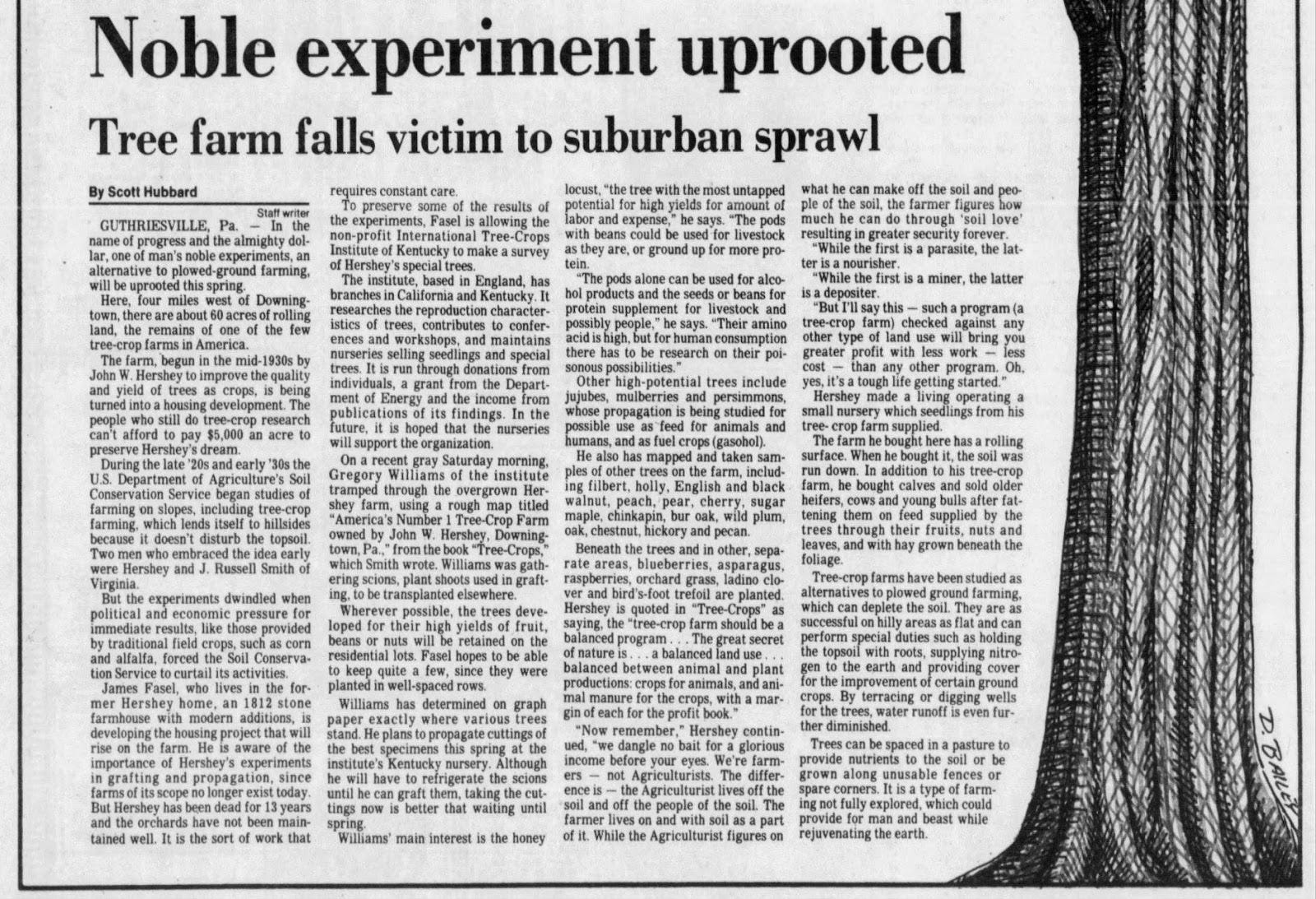
Greg: There’s a lot of material down there that’s just been left for this Mr. Fasel [James Fasel, Downingtown, PA. He was the developer who bought the Hershey farm.], or whatever.
Elizabeth: No, Mr. Fasel, he doesn’t have any left I'm pretty sure, because he is not interested in trees, he just slashes them down builds houses, ya know, and it’s a shame because that was our agreement, it was really a shame, not because my husband did it, but we had an arboretum there, all sorts of hickory, and also some oak, it makes you sick, the way they gonna do it. I was worn out, we had no money, everything was tied up in the farm. We couldn’t, we couldn’t go – and he wanted to start a foundation, and probably would have done that too, … and probably if he would have lived, he probably would have gotten it… but he was sick a lot of years ya know.
GW + Brian: Yes I know.
Elizabeth: He had tumors sarcomas starting in the 30s, and he got an awful lot done when he bought that farm… he laid it out, planted it, ya know, and all that sort of thing.
Greg: Did John die in 1967?
Elizabeth: Mhm.
Greg: When you were on the farm, and doing nursery work, did you have many people outside the family to help, or was this a family operation?
Elizabeth: Well no we had to, no we had to get help, especially when we dug trees, you know what I mean, and for the grafting and the propagation we had Kitty, and before Kitty we had – well his pictures in there – Jack Pannebaker [John, aka Jack Pannebaker, born 1914], he was with us 18 years. Then when the war came along his father thought he should get into defense work, so he had an ironworks in there, and we lost Jack pretty much, he couldn’t graft and all that sort of thing, he was quite a boy.
Greg: I see. And then your daughter helped with some of the grafts.
Elizabeth: Oh yeah, she was outside. Well she was adopted, she came to us when she was a little girl, and she started to work in the nursery, you know, just climbing things, and doing things like that. And she stayed with us through highschool, you know what I mean, she worked in the nursery. Now her mother and father were living, but then, after that, when she was about 13, that’s when we adopted her.
Greg: Apparently, um, all…
Elizabeth: And she learned how to do things, and she was the outdoor type, you know what I mean? She could graft trees, and she could take care of them, and she could work the horses, ya know.
Brian: Oh yeah?
Elizabeth: We had an old falling apart [?] tractor there [..], but nobody could start it, they had to yell for Kitty, but Kitty had cleats on it, you know about that, on the wheels, you know. We used to use it for the big tree moving, and for the digger to dig thing, you know, and that sort of thing.
Brian: Huh!
Elizabeth: But she’s not interested in this anymore! We all worked so hard there I think we were glad to leave the place, we retired, I’m telling you, I was done in at the time we got things straightened out. And no money to go on, you know what I mean, we had a time, we had two sales down here.
Brian: Two sales of what?
Elizabeth: Well, farm sales and things like that. But makes ya sick when I go down there, and he doesn’t want you to be on the farm, [..], Mr. Fasel
Brian: He doesn't?
Elizabeth: I haven’t been there in many years, ya know, I wouldn’t know. Once in a great while I think he stretches [?] upon it.
Greg: Well, there’s a fella that we’re gonna be staying with tomorrow night, or I’m going to, and then Brian’s gonna go back home, but, uh, Lowell Melick [Lowell Melick of Chalfont, PA] who was there in the spring and talked with Mr. Fasel. Apparently, it wasn’t too strained, between them, so…
Elizabeth: Well, no, he’s a fine man, he really is a nice guy. I like him and all, and he was very good to me and Kitty [?] and all that sort of thing, but trees don’t mean a thing to him, you see.
Greg: Yeah, yeah. Lowell said he was doing a lot of fruit collection [?] [..]
Brian: Well, how long has it been since you’ve been in there?
Elizabeth: Well we left when John died in ‘67, and we left in ‘68?
Brian: You haven’t seen it since?
Elizabeth: Not very much, no! I was in, where they turned the packing house into an apartment, his, Mr. Fasel’s mother was in there, and we went to see her, but I've never seen what happened in the back, ya know what I mean. And they never asked me and I never pushed myself on them, because I know they don’t want me to, very much.
Greg: Lowell said there was actually quite a lot of trees, good material left, and trees that people should graft…
Elizabeth: Well he should have rezzz[?] the people who might want them, there’s no reason why he shouldn’t. I think it should be mandatory, you know what I mean, that he has to get it to the people to propagate these trees.
Greg: Well that’s exactly what we’re trying to do, is save these good varieties that John especially located, I only know of one place, that for instance, the Kitch persimmon can be found now. Uh, they’re in…
Elizabeth: Well that’s why I was talking to uh Miles Hurst, I said he’s up about [..] mile there, he has some Kitch persimmon, and he just loves them, they hang on till just…
Greg: What's his name?
Elizabeth: Miles Hurst… oh no no, excuse me! I got that mixed, Miles Hurst is [..] this is Miles Nolt! Mhm.
Brian: Nolt?
Elizabeth: Mhm, yeah.
Greg: How do you spell that?
Elizabeth: N-O-L-T
Greg: Is he is with the Pennsylvania nut grower’s then, now?
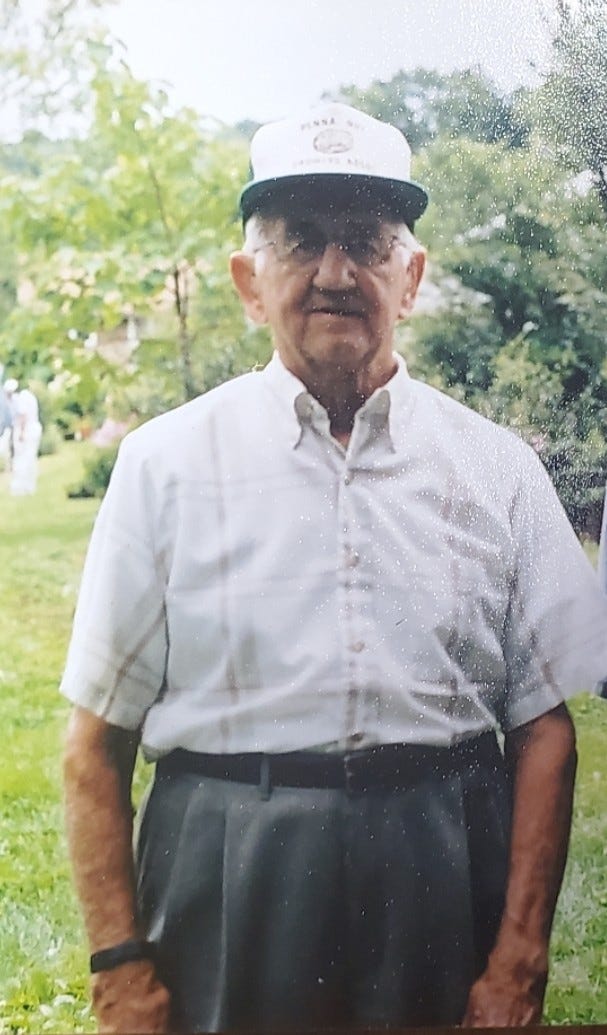
[Miles O. Nolt, 1906-2005.
Miles was an influential figure in nut growing and Asian persimmon culture in and around the Lancaster county area. Jere Groff, an area nut and fruit farmer, tells me that Miles Nolt became interested in Asian persimmon when John Hershey visited, and pointed out a row of chicken houses situated above a sunlit hill. John says, “You can grow Oriental persimmons alongside there!” And Miles did. It is through Miles’ influence, in turn, that other growers began to pick up Asian persimmon culturing in Lancaster county.
When John was on his death bed, Miles came to him with lots of questions. John was known to have many trade secrets. For example, his grafting success on hickories was 90%. Miles talked with John for a long time, and John revealed to him everything he knew.
Miles Nolt is also known as the introducer of Longenecker shellbark hickory, which came from a tree at a nearby relatives’ in Lancaster county, PA.
Miles wife Irene, was a relative of John’s, his cousin on the Eby side – Eby was John’s mother’s maiden name.]
Elizabeth: Yeah, mhm. I ran into him [?], you know, I’ve tried to get some from it [?], says I should join [..].
Greg: Yeah. Where does Miles live, Miles Nolt?
Elizabeth: Now his address is, uh, rt 1, I think Manheim, wait a minute, I’ll see if it’s in there, I thought I had it [..]. I have his telephone number, ya know. It’s, um, route 7.
Greg: Route 7?.
Elizabeth: Mhm. You want his telephone number?
Greg: Yes please! That would be nice .
Elizabeth: Well it’s 665-
Greg: Yes.
Elizabeth: -5760. If you call from here [unintelligible – she is probably saying you won’t need to worry about the long distance], you know what I mean.
Greg: Yeah, ok. Apparently from what I've read of John’s annual progress reports, your farm was already an organic farm, or pretty near to it.
Elizabeth: Yeah I would say that because when we were there at the other nursery, you see, would get all their leaves [sounds like she is saying “trees”] from the borough, we had long lines of leaves, you know, and John would compost ‘em and use them, we had good rich soil there anyway, it was sort of bottomland, you know, it would wash from [..]. We were starting in the bottom part you know, and it would come down from the hills, we had good soil, and John would uh, he’d send to New York [..] Spring Valley [..] [for a biodynamic preparation?]
Brian: Oh yeah!
Elizabeth: To get the compost started, uh huh.
Brian: The biodynamic people.
Greg: Oh I see.
Greg: Did he, did you have contact with the Rodale people, Organic Gardening magazine..?
Elizabeth: Not too much, but we used to get that all the time, you know. And I think the Rodale’s weren’t around at the time [..].
Brian: How about the Pfeiffer’s, were they around?
Elizabeth: Dr. Pfeiffer [Ehrenfried Pfeiffer, 1899-1961]? Yeah. Yeah now let’s see how’d we get in touch with him. John used to go to New York when he had sarcoma, you know, he’d go up there for treatments, and this, these men were sorta, uh, people like that, you know what I mean?
Brian: They were trying to give him, uh?
Elizabeth: I'm just wondering where Pfeiffer came in. He died, didn’t he, from the cancer I believe?
Brian: I don’t know that much about it, I think he’s dead.
Greg: Yes.
Elizabeth: That's [..], that’s funny, I hadn’t thought of him for a long time. Do you know where he lived?
Brian: Well I have heard Spring Valley.
Elizabeth: was he in New York or something?
Brian: He was in spring valley.
Greg: Was it on Long Island?
Elizabeth: Oh, up there, yes! Spring Valley, sure, that’s right. Well I, uh, every once in awhile I'd get it, I'd take him medication that I’d send up there whenever he needed it. A bottle will last me about a year, you know, it’s some sort of organic stuff, and everything, and I just like a helping hand [?]. And I keep in touch with him, like that [..] Pfeiffer was there.
Brian: Well does Miles Nolt have any of the oak trees and stuff too?
Elizabeth: I don’t think many of them, no. He’s more into the nuts side of it. And honey [unintelligible] that’s one tree that would do well in the droughts out there.
Greg: Yeah, in fact, I wanted to ask you, if you knew, or have you heard of Samuel Detweiler [Samuel B. Detwiler, 1881-1973], who worked with the Soil Conservation Service?
Elizabeth: Oh yeah!
Greg: Well this was copied for me by the TVA people, it’s called “Notes on Honey Locust” and he did this in 1947. [A copy exists today at the National Agricultural Library in Beltsville, MD.]
Elizabeth: How about that.
Greg: Everything that everyone ever wrote about honey locust.
Elizabeth: Oh yeah, these other folders that are John Henry’s [that is, John Henry Kitch, 1924-2012 – John and Elizabeth’s nephew from Elizabeth’s side], you know what I mean, are honey locust mostly, I thought that was a thing you were interested in.
Greg: For me, yes, my main research [..] is honey locust.
Elizabeth: But John Henry has some other… we call him John Henry, he’s always had the two names together since he was a little kid. Anyhow, he uh, I gave him the scientific files because he was…
Greg + Brian: That’s good.
Elizabeth: And he wants his honey locust stuff back too, you know what I mean.
Greg: Ok, he told me he had some folders to show me together, that’s really good, that’s really good.
Elizabeth: Let's see.
Greg: Well I'll tell you what I've done, I've been successful at locating most of the varieties that John found in the TVA, and then Mr. Schofer [Robert Ramond Schofer, 1883-1966, owner of Schofer’s Quality Bakery, which had multiple locations in the Reading, PA area] found a good variety, ah, and there’s a Smith variety I think that John found, up here, and uh, now we’re propagating from those trees and we’re also getting seed from those trees to do breeding work for honey locust. There’s two real interesting things that have come up. One is that the pods, uh, are apparently a possible source of alcohol production, for the energy crisis.
Elizabeth: Oh boy!
Greg: And second thing.
Elizabeth: I never thought of that, [..] what’s the one, 33 and a third percent sugar, or something like that?
Greg: Calhoun and Millwood are the ones that are pretty high.
Elizabeth: Yeah, uh huh.
Greg: The other thing is that the seeds, not whole pod, but just the, the very hard seeds inside, when ground the protein is a very high quality protein, the amino acid composition, very good in terms of what humans need.
Elizabeth: This is something new they found?
Greg: Just in 1976, they found.
Elizabeth: Who worked on this?
Greg: Ah, a fellow named Peter Felker [Peter J. Felker, graduated MSU and then went on to University of California, Riverside. Wrote his thesis at MSU on leguminous tree crops as low-input energy production: https://d.lib.msu.edu/etd/42796] who was then at Michigan State University, and now he’s out in California.
Elizabeth: Mhm, well that’s interesting, because it does have possibilities with all the sugar it has. Did you say the alcohol business now, are they’re gonna use that and stir with part of our gas?
Greg: Yes. So, the idea is that pods can be used either to fatten livestock, or alcohol, and then the seeds can be used for direct human consumption as a protein supplement.
Elizabeth: Well you see John and Schofer worked on this bread business, they had some ground up and they baked some bread from the honey locust.
Brian: Yeah, tell us about, did they sell very much of this stuff?
Elizabeth: I don’t think they sold anything, it was just an experiment, enough to know a batch [?], know what I mean?
Brian: Now did Schofer have a grove of honey locust trees?
Elizabeth: I don’t think so! I don’t think so. But I think that, uh, his job was baker, he had a big bakery, and I believe he had these around, yet John Henry said, I don’t know. John Henry could tell you too.
Greg: He mentioned that this morning when I called, he said that we would try to talk with the Schofer’s about honey locust.
Elizabeth: Now John might, I don’t know whether he’s gonna give you any of his time next week, you ain’t gonna be here next week?
Greg: No, we’re just gonna be here through tomorrow…
Elizabeth: Because he thought, you know, his job is such that he could take you around as part of his job, you know what I mean. [John Henry Kitch was a forester.]
Greg: Yeah. Well we’ll be back probably sometime sooner than later, and see more things then.
Elizabeth: [unintelligible]
Greg: Well there’s a, I went through the progress reports, looking for interesting things, I know that, uh, it did say that the Schofer’s planted 5 acres of honey locusts in 1941.
Elizabeth: Oh that there, I see [?], that was ‘41 you said?
Greg: Yeah, these are from the different progress reports. John, when John was working on the William Penn Oak selections of very old oak trees, trees that were here when William Penn was here [..].
Elizabeth: Oh yeah, there’s one great big one they take care of down at Oxford south of here about 20 miles maybe. And it stands right in the middle of this little town, you know, and they really, you know they keep tree surgery [..] and they keep it in good shape, yeah. [This tree is mentioned in Penn’s Woods 1682-1932 by Edward E. Wildman.]
Greg: Well, does it have sweet acorns, or is it just, uh…?
Elizabeth: Well, fairly, [..] one of the things [..] whether it had so much, it was so hardy, John thought that would be a good thing to have seeds from, you know what I mean. It was a white oak. Well he had the burr oak, and the basket oak, and the willow [?] oak, and, I don’t know [..].
Greg: We’ve located, uh, three of those, which people have got and got scionwood from John, and there still alive, and we can propagate from those, but uh probably so many others are lost.
Elizabeth: We had the turkey oak, that will grow where the other ones won’t, you know what I mean. We’ve planted some trees, oak trees, they wouldn’t bear where [..] you planted turkey oak. And it’s a very pretty tree too, [..]. Did you ever get in touch with [unintelligible, could she be saying Ernie Sh___]?
Greg: [sounds like Ernie Sh___]? No.
Elizabeth: Did you ever see him written up?
Greg: I've seen his name.
Elizabeth: He was a plant breeder when John was down at, uh, Tennessee.
Greg: Well they worked together on crossing Millwood and Calhoun honey locust, I know about that, and John said that, uh, the Millwood, was a perfect flowered tree, I remember that from this Notes on Honey Locust. John apparently at two different times was writing books, do you remember about that?
Elizabeth: Not too much, unless they were just small books, I mean, he probably read, I knew he’d find a lot of data for a book, you know what I mean?
Greg: Ok. Yeah. In 1951 John took trees, I guess he moved trees up here from the J. Russell Smith nursery when it closed down.
Elizabeth: Yeah, [unintelligible] I think. [*Elizabeth groans]
Greg: Oh yeah, I bet that was a real mass movement of everything.
Elizabeth: Ahh! Oh what a job that was! Haha. Because they were big! They were big heavy things, you know.
Greg: Something I'd like to know about is this tree blackberry, do you remember about that? John said that it was a real wonderful plant.
Elizabeth: Yeah
Greg: But I don’t know of anyone who’s got any more, but you know anything about that?
Brian: They were variable, mhm.
Elizabeth: Yeah, now, but I can’t tell you much about it [..]. Was that when we were in Downingtown, I think at the farm?
Greg: Yes, it first was mentioned in 1948 in the progress reports and then also in ‘51 he was talking about it doing real well again.
Brian: Was it a Rubus?
Greg: I don’t know. That was [..], he didn’t say, or give the species name, so I wanted to try to find out something about them, uh, maybe Mr. Kitch would know more about it.
Elizabeth: We had several black walnuts from trying to trace one down now, but I don’t know what the nut is like, we found, it was found in the seed bed in Pennsylvania… seed beds, you know what I mean, they planted, uh, a one or two [unintelligible] reforesting, and all that sort of thing. It was a cut leaf, and we stuck it in their garden here, [..] by which was wired off to keep the chickens and everything out. And the thing was awfully slow getting started, and it was a pretty thing, and John went and grafted several of those. And you’ve heard of Ms. Mildred Jones [*Mildred was the daughter of J. F. Jones, famous tree crops nurseryman and John’s mentor, who passed in 1928. Mildred continued to operate her father’s nursery for a number of years after his death and maintained association with the NNGA and carried on innovation and correspondence.], I guess, haven’t you?
Greg: Yes.
Brian: Yes.
Greg: Yeah, I've seen her in picture in old Northern Nut Grower’s…
Elizabeth: She had some, and you know, and I think trying to trace one of those down, John Henry’s very anxious to get one of them.
Brian: Huh!
Greg: Well we might be able to help with that.
Elizabeth: Now Miles didn’t know anything about it, and he has practically everything else. We had that, and we had the purple-leafed black walnut.
Brian: Purple-leafed black walnut!
Elizabeth: It was sorta… but that, I think it’s gone. It’d been in the nursery not too, well, a couple years ago maybe, and a lot of the things were gone, because there’s apartment houses in there, and John Pannebaker [she seems to say John, not Jack – but I think John and Jack are one in the same, Jack being the nickname.] used to live right close to the nursery, you know, because that’s where he worked. This is the boy who was with us 18 years, you know, and he’d always go down and gather up the, well we had a lot of berries there of course, and you know they were growing wild and all, and he’d go down and gather the berries and the nuts, he was crazy for them, [..] the Thomas black walnut, you know, we have all these wonderful nuts here now, because we were there, just there.
Greg: Does John Pannebaker still live?
Elizabeth: No, he's dead.
Brian: We have uh, Cornell has a cut-leaf plant black walnut.
Elizabeth: Do they? Well now that might be it! Because that’s [..]
Greg: Yeah, that’s it, and you say you’re, that John Kitch is real interested in trying to locate that?
Elizabeth: He’d love to have one, mhm.
Greg: Well I think we could help him out.
Brian: We could send him scionwood.
Greg: Yeah, we could send scion.
Greg: Also, yeah, ok, we could do that, that would be real nice. I told John Kitch when I wrote to him, that I'd be happy to send him some wood or grafted tree of the Kitch and put [?] it on persimmon and he didn’t…
Elizabeth: Well doesn’t he have it?
Greg: Ah, well, I don’t know, I just wanted to [..]...
Elizabeth: I don’t know if he has it or not.
Greg: Was that named for him, or for his, his?
Elizabeth: His dad.
Greg: His dad.
Elizabeth: Mhm. His dad used to help us in the nursery sometimes, you know.
Greg: I wanted to look at the farm there, um. [*Examines copy of Tree Crops.]
Elizabeth: Oh I didn’t know it came out in paperback.
Greg: Yeah it just published v–, the reprint in paperback, seeing as there’s a lot of interest among young people now because of E. F. Schumacher [Ernest Friedrich Schumacher, 1911-1977], have you heard of him? The smallest vehicle, or appropriate technology guy?
Elizabeth: No, the name strikes a bell but I don’t know what he’s written.
Greg: His idea is that particularly in the third world, or underdeveloped countries, we need to do things which involve more labor, and less machinery, because there’s so much labor there that’s just unemployed, if we do…
Elizabeth: Sounds good!
Greg: …American standard kind of agribusiness, and so Tree Crops is really important in that thing, and look he wrote the back thing on here, but this was reprinted in 1978. It’s the second edition of Tree Crops just like the original edition, you know. [*The sound of pages turning.]
Elizabeth: Well that’s great, what does it sell for? Most kids can have this?
Greg: Uh well, it’s list is $5.95, in our organization we get it, we buy from a distributor and sell it for $5 post-paid to try to get more people.
Elizabeth: That’s great, the younger they are [?], the people should have that, you know.
Brian: Yeah
Elizabeth: Because they are becoming interested in this, in the reforestation business and planting more trees to hold our soil, and they’ve bought, uh [..] if there are Arabs buy all our land up, all these oil people, we’re not gonna have much left! It makes me sick, it makes me sick, to tell you the truth. You have, have you been up to Lancaster county through the Amish country?
Greg: Oh we just…
Brian: Not too much.
Elizabeth: They’re not so much for trees, but they really have beautiful farms, you know what I mean? And their soil, um, analyzes about the same as virgin soil, you know, they put into their land what they take off, of course they have a lot of manure, they have horses [maybe: they use instead of] the machines, and they have a lot of stuff like that. It’s really great.
Brian: Yeah.
Elizabeth: But we’re reducing that [?] too, you see!
Brian: Was that being bought up, is that it?
Elizabeth: Oh yeah! Well now not so many of the Amish, but the other people around them, you know they would pay fabulous prices an acre for the farms up here, it’s ridiculous.
Greg: I know that in our area of Kentucky, Amish are coming from Lancaster county because they’re running out of room for their children.
Elizabeth: That's right! They have three or four boys, you know, and they want farms for each one of them, you know.
Brian: They have a fair amount of money, don’t they?
Elizabeth: Oh yeah, they’re thrifty. They have each other. You don’t find them on relief or anything like that, if a barn burns down, they all flock together next day. Oh yeah, it’s beautiful, it really is. They’re intelligent too!
Brian: You know I wonder why we can’t do that kind of stuff? Hahaha.
Elizabeth: We have to have too many things, and their houses are..
Greg: That’s right, we have to have too many things, it seems, that’s the only reason.
Elizabeth: That’s right, and that’s too bad.
Brian: Mrs. Hershey, why do you think that the interest sort of faded away in tree crops in like the ‘50s?
Elizabeth: Well I, there weren’t many people interested in that, there weren’t so many interested there now, you see [..]
Brian: Well I wonder why that didn’t happen?
Elizabeth: Well, there weren’t enough people to teach them, you know what I mean! This is why John always blamed the government, well I feel pretty badly about it myself, they never made much progress, you know that, in the United States department. They never made much progress with nut trees, they worked down there and they never had much to show for it!
Greg: There was no money, they never made much available.
Elizabeth: Well, don’t worry, [..], don’t expect much money, even now. Because I'm telling you, you work and work and work. Well, first it’s a long process then too. People don’t want to wait, you see, either! To propagate nut trees, look how long it takes a pecan to grow, to bear and all that sort of thing.
Greg: That's what our neighbors say. [*Greg says in a sigh.]
Elizabeth: Or even black walnuts and things like that, you know. You have to have a vision, that’s all there is to it.
Brian: Yeah, it’s true.
Elizabeth: You have to be a missionary, you don’t want it to make money [?], because you’re just gonna be… stuck!
Greg: Yeah, that’s where we are. The one thing about it is I've found the people who grow trees are quite different from the row crop farmers. They do have a vision, they do have a sense of the future.
Elizabeth: They must be, because they have to look so far ahead if they want to, mhm. I wish you could see this old man, I haven’t been up there for awhile, but he’s has a lot trees.
Brian: Yeah, that’s sounds real interesting.
Greg: This, I guess, this…
Elizabeth: You know I have a picture, of a plane picture, you know, bird’s eye view.
Brian: Aerial photo.
Greg: Oh you do?
Elizabeth: But I can’t find it! I don’t know where it is.
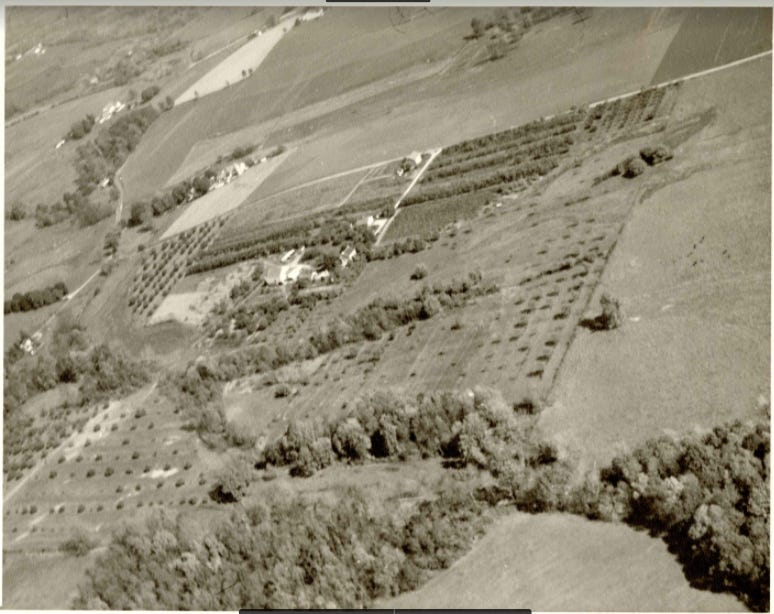
[Here is that photo, taken in the ‘50s.]
Greg: That would be real interesting.
Elizabeth: You know I'm 79 years old and I don’t have the energy I'd like to have and I've too much to do, I'm gonna close this place out in a year if I can.
Brian: Oh yeah?
Elizabeth: Yeah, because I don’t have the energy to keep after it with all the repairs, and the painting, you know, and so on and so on, and I just can’t keep after it. I've got a lot of things, too!
Greg: I'd like to ask you that, or to tell you that, if there comes a time where you were going to have to get rid of materials, we would buy them or…
Elizabeth: Well I don’t have any!
Greg: Well, ok, anything.
Elizabeth: Like what?
Greg: Anything of John’s.
Brian: Well, I like that aerial photo.
Greg: We would like it to preserve it, put it into a library, we have, we’re the recognized international tree crop library for the International Federal for Organic Agriculture Movement [
https://www.ifoam.bio/
].
Elizabeth: This is a [..] John had a big nut collection here, these are the one’s that Kitty picked out to keep, where do you wanna, do you wanna sit over here?
Brian: Well that’d be interesting. Sure!
Greg: Sure.
Elizabeth: [*Sound of rustling nuts brought out of a box.] But we… oh we had all these hickories [..]. Did you ever hear of Mr. Bixby?
Brian: Bixby? Yeah, I've seen the Bixby hican.
Greg: Look at this Brazil, cream nut.
Elizabeth: That's of course a Brazil nut, Kitty kept that because she thought it was ..
Brian: It was big! Haha.
Greg: Yeah, they are.
Elizabeth: Well, you see how they grow, just, well if you hold that up, you can see the Brazil nuts inside that case.
Greg: Korean chestnut, pinenuts, peanuts mailed by Arth… Arthur S. Cunningham, spring of ‘52. [Possibly Col. Arthur S. Cunningham, 1921-2017 of Gettysburg, PA, who would have been overseas in Korea in the war at that time.]
Brian: Hm!
Elizabeth: Korean pine!
Greg: This is a Korean pine cone?
Elizabeth: Well yeah these seeds have all dropped out, but I think you’ll find some this evening.
Greg: Yeah, I'm gonna be working with that.
Brian: Have you ever tasted one of these Hall’s hardy almonds?
Elizabeth: Yeah, but they’re very [..], they’d not like, they’re not like the soft shelled now.
Brian: Are they pretty bitter?
Elizabeth: well not as bitter as a peach seed, you know what I mean, but it has a little more sugar in it, I mean taste than that to it.
Brian: Good.
Elizabeth: You wanna taste one? Probably be bad!
Brian: Yeah it’ll probably be no good anymore… w-oah! Now there is a Persian walnut
Greg: I imagine… I've never seen anything come close to that!
Elizabeth: I only get [..] nobody else knows about that tree.
Brian: Well you know what, there’s a Fately #5 that is the same size, same size, yeah.
Elizabeth: Is that right, well maybe [..] from the same tree.
Brian: I find it [..] for me though.
Elizabeth: Some little old man had that, he took over there at, uh, it was [..]
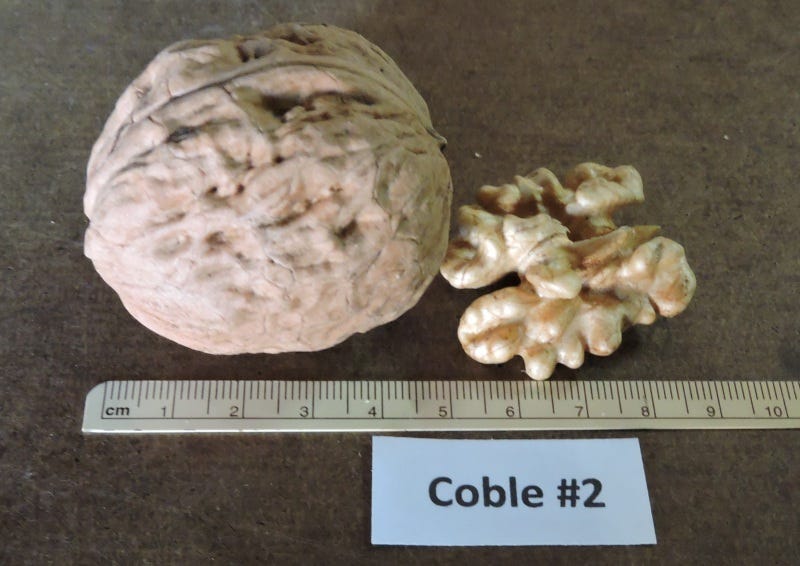
[Elizabeth could possibly be referring to Garnet Coble and his Coble #2 English walnut, which was his introduction, and one of the largest grown by Pennsylvania growers. Garnet and John knew each other. More on him another time.]
Brian: They sure are impressive, aren’t they?
Greg: Yeah, no kidding.
Elizabeth: Well it’s not too bad, it’s a little [..], hahaha!
Greg: That's quite impressive. That’s pretty amazing.
Elizabeth: Well what I was gonna say, John’s brother in law worked down here at uh, middle of Paradise on the Lincoln Highway, about 30 miles, he had, uh, he was sort of curator of a little, it was about, uh, steam engines, you know what I mean? That you use to steam tobacco beds, and do things like that, steam engine, you know.
Greg: Yes.
Elizabeth: And they had, they also had great big rally there every year [This is the annual Thresherman’s Reunion which takes place on the grounds of the Rough & Tumble Engineers Museum in Kinzers, PA. On the grounds are several grafted English walnuts.] but anyhow John gave him, er I gave him the nut selection, and he had them down there, there were all sorts of hickories there then, and he passed away, and I wondered what about that now, maybe I could find some [..].
Greg: What was his name?
Elizabeth: Hershey? Hahaha. John’s sister married a Hershey. Excuse me.
Brian: Oh yeah? But that wasn’t in some sort of a display or exhibition?
Elizabeth: Yeah it was somewhere [..], it was a museum you see, and they had it where people could see it and talk about it and everything.
Greg: And where was the museum, it was at uh?
Elizabeth: It’s off of Route 30.
Brian: Huh.
Greg: What was his first name?
Elizabeth: Well it was Willis [Willis Leamon Hershey 1897-1976], but he, as I say passed away, somebody else has it, and I don’t know, I haven’t been there, and his wife is older than I am [*Elizabeth chuckles to herself] so I don’t know if she wasn’t too interested in chasing things like that, but I don’t know if she would know what became of the things down there or not
Brian: You don’t think they’re still on display?
Elizabeth: They might be, I don’t know, I could probably find out for you. But now what I was gonna say is Dr. Bixby did an awful lot with hickory, you know, and he had all sorts of hickories.
Greg: His collection was apparently wiped out when he died, from what I know. This was on Long Island.
Elizabeth: Mhm. Well, John had a bunch of it, see what I mean? And we didn’t know what to do with them so, Willis would like to have showed them down there so he gave them to him.
Brian: Mhm. He had the nuts?
Elizabeth: Yeah, mhm.
Greg: Could you say one more time that, it was at the middle of Paradise?
Elizabeth: No it was below Paradise, it was around Kinzer. The address would have been Kinzer Pennsylvania.
Greg: K-I-N-S-U-R?
Elizabeth: Z-E-R
Greg: Z-E-R. Well
Elizabeth: And I don’t even know who to write to see who the man is that’s taken charge now, you see. But I could probably find out. My lack of interest, my lack of strength, is what keeps me, haha, you know I don’t have the energy I used to have!
Greg: You’re active in a lot of things still though, aren’t you.
Elizabeth: Well I try to be, I have an old Studebaker that takes me every place. [*Elizabeth lets out a loud chortle] Best old car I’ve ever had! Hahaha.
Greg: That’s great, I've heard a lot of people say that, well a few people, there’s not that many of ‘em.
Elizabeth: But I just can’t take on too many things, it wears me out mentally. Well my mind gets tired, I really, it really does.
Brian: Well you seem pretty on top of it this morning, that’s for sure.
Elizabeth: Well I'm usually that way, but then I mean I just can’t too many things on. And I'm. [*clears throat] If we would have had time, as I say, we didn’t have time to live there, money to live there even. Kitty wasn’t working because she was working on the farm, you see what I mean? We had to have heat and all that sort of thing, and I'll tell you, we were poor because it was all in the farm, you know what I mean? I used to call it the Sinking Fund Farm when John was sick.
Greg: Sinking Fund Farm! [*chuckles]
[*The telephone rings.]
Elizabeth: And anyway, excuse me…
Greg: Sure.
[*Telephone rings again.]
Elizabeth: [*Elizabeth picks up the line] Hello? [*Pause] Well she, we’ll probably go down to Park City [Park City is the local shopping mall complex.]. I'll see ya later. Ok. Alright. [*Click]
Elizabeth: What was I gonna start to tell you about?
Greg: You were talking about Sinking Fund Farm. [*Laughter]
Elizabeth: Hahaha. Oh what I mean, if we could have had more time to change over, you know what I mean?
Brian: Change over to what?
Elizabeth: To move and not care, and moving where we wanted to move, to, we couldn’t afford to stay on the farm, see what I mean?
Brian: Right, mhm.
Elizabeth: And why, we could have probably saved a lot more things like the literatures and things like that. When I was worn out, John had been sick so much of the time, I nursed him at nights for nights and nights and nights, you know what I mean?
Brian: Yeah.
Elizabeth: And I was really worn out so I know a lot of things slid by. And [..] could apologize for me, I just couldn’t handle it.
Greg: I'm curious to know if there were any younger people who would ever come around and try to find out about you, because so many people, there are just very few young people in the Northern Nut Growers.
Elizabeth: Well now this [..] man used to come around, he used to come down with his father, and you know when you’re in this business, they’ll come and spend a half the day, take your time, haha, you know. It’ll drain you dry! But you won’t get anything for it unless he buys a few trees, you know, that’s part of the game.
Greg: Yeah. Yeah.
Elizabeth: We had a doctor in Downingtown, and I'm a nurse, and I thought I could handle things pretty well while John was sick, you know. Still I was worried about him and I tried to tell him, and I called doctor Burton [?] I think I've called him four times while John was sick, and his wife answered twice, so he charged me a dollar for each call. And yet Dr. Burton [?] was planting trees you know, he went to the service and he asked John if he would take care of the trees, with his dad, while he was in the service, John said sure. He said I can’t go to the service and take care of those trees. Of course, John never charged him a cent for that, the whole time he did it! [*Laughs] But that’s a doctor for you, you know what I mean? They can charge anything, but if he dies, he will owe his money first! You better be wealthy. Haha.
Greg: Can we look at the materials that you’ve collected here?
Elizabeth: Now this is just some things that I've come across, and this is the honey locust stuff, and you might find some things in here, I don’t know.
Greg: Now, I've never seen one of these, I've seen a 1962 price list, would it be possible for me to have one of these? Just, there’s three of them.
Elizabeth: Oh you might as well, there’s, I think there’s only one there, but why don’t you take them.
Greg: Oh I see, there. You wouldn’t mind if I took a copy of each of these? In fact, I could make photocopies and send them back to you if you wanted.
Elizabeth: I don’t think you need to. Yeah I'm sure you don’t want this, when we were having trouble with the…
Greg: Well, as I said, I would like to have anything that John wrote, that I could…
Elizabeth: Ok well maybe you’ll find something here today.
Greg: And uh, because uh, we would like to preserve it in a historical sense. I think that John’s, both of your pioneering work in tree crops needs to be preserved in the historical record, and it’s not going to be…
Elizabeth: Well you know even John said he got more credit than he ever got before [?]. You know he did get a lot of credit, because of his Dr. Smith who got him into the Tennessee Valley Authority, you see, and, uh, Dr. Morgan [Arthur Ernest Morgan, 1878-1975] was the chairman of the thing and he and Smith got together and they were really, Dr. Morgan was really interested in the tree crop things.
Greg: I have a friend…
Elizabeth: But they didn’t like John too well. I guess you knew that.
Greg: Yeah, I know that the Tennessee Valley Authority, uh…
Elizabeth: They don’t give him any credit [..].
Greg: Apparently needs to have people who are real high credibility, you know, academic people.
Elizabeth: Yeah, well John…
Greg: I have this and I recommend you keep that, because that’s a wonderful little pamphlet.
Elizabeth: Well I have several if you want to pass that to anybody.
Greg: Ok, I can take this all, well, I'll have that, I have all the back issues here.
Elizabeth: No I wanna keep that. [..] John in there, and I would like to keep it.
Greg: Yeah I have all the back issues of those. That’s how I found out where you were, I read that and looked at Lancaster and so I just called the operator and asked if you were, uh, if you had a phone.
Elizabeth: Oh really!
Greg: Oh this is interesting, there’s an address of Lowell Melick, and uh, that’s who we’re gonna be staying with.
Elizabeth: Oh I'm, oh that’s my writing isn’t it, I put that there in there. Well you must have told me about him!
Greg: Well maybe I did on the phone, maybe I did, I mean that’s [..]... Oh yeah, he’s material from us, ok. Ok this is from us.
Elizabeth: Well that’s the envelope you’ve seen, you see, I just kept it intact because otherwise I lose things.
Greg: Yeah, yeah. This is… you should keep all this.
Elizabeth: Well now I don’t know whether ah, you’re not going to have time to look over this and I don’t know whether… I know John Henry don’t wanna part with it. So why don’t you take it along and ask John Henry about it, you see, if you think you aren’t gonna see him, don’t take it, because…
Greg: Oh no, we’re going to, we’re going… I told him we’ll be there at noon.
Elizabeth: Oh, mhm.
Greg: So yeah definitely, well I can take this right to him.
Elizabeth: Well now here’s material for a book.
Greg: On honeylocust!
Elizabeth: Yeah, mhm.
Greg: Wow!
Brian: Huh!
Elizabeth: Hahaha.
Greg: Definitely [..], good find [..]. Did you ever do anything with earthworms?
Elizabeth: Oh John sent down here, he sent to California, they drive back, chuck em in, yeah! put ‘em in your compost beds and places like that you know.
Greg: Here this is mine this year that I sent to you, so.
Elizabeth: Ok, mhm. Here, here’s the other folder. Now mind, I'm giving you those because John Henry said he wants them back! I had them ‘ever since you gave me the first folder.
Greg: I realize that. My mom was very sick and she died in January, and so I've been planning to come in the fall, and then it had to get postponed, in fact, when we were going to her funeral our car was hit in the rear and we got, we were totaled, so we had to get a new car and all this other stuff, so.
Elizabeth: Oh I'll be, so it’s too bad, so I understand that, but, oh I know ya got busy too you know what I mean? But I uh…
Greg: Well, we’ve been very busy, I…
Elizabeth: But I mean that’s how long I've gotten ‘em from John Henry I was up there in August and [..]...
Greg: Well what I'll do is, some of this material I think he’ll probably let me photocopy but I'll ask him about it all before I take any of it.
Elizabeth: Yeah. That’s about all I had gathered together. I'm just trying to think if there’s anything else I can tell you about, like the cut-leaf black walnut… purple-leaf…
Greg: When your nursery finally, I guess you had a sale in ‘67 or ‘68, where did the material in the nursery rows go? Is it still there grown up in the nursery rows? That hadn’t been sold.
Elizabeth: Oh you mean the trees, yeah, mhm.
Greg: So there’s a, there might still be a nursery area there with…
Elizabeth: Well I'm sure there are, [..] seedlings in there, because I know we had a lot of poplars through there and [unintelligible].
Greg: Hybrid poplar?
Elizabeth: Shiner’s poplar, hybrid too [?].
Brian: Oh yeah?
Elizabeth: Mhm, and some of those, and of course we had rows of pecans, and hickory, and black walnuts we were growing up, we sell ball trees, you know, that means we’d have to ball ‘em, and sell it for estates and things like that, as a matter of fact we had, I don’t know if you’ve ever heard of the duPont gardens, Longwood Gardens, and all?
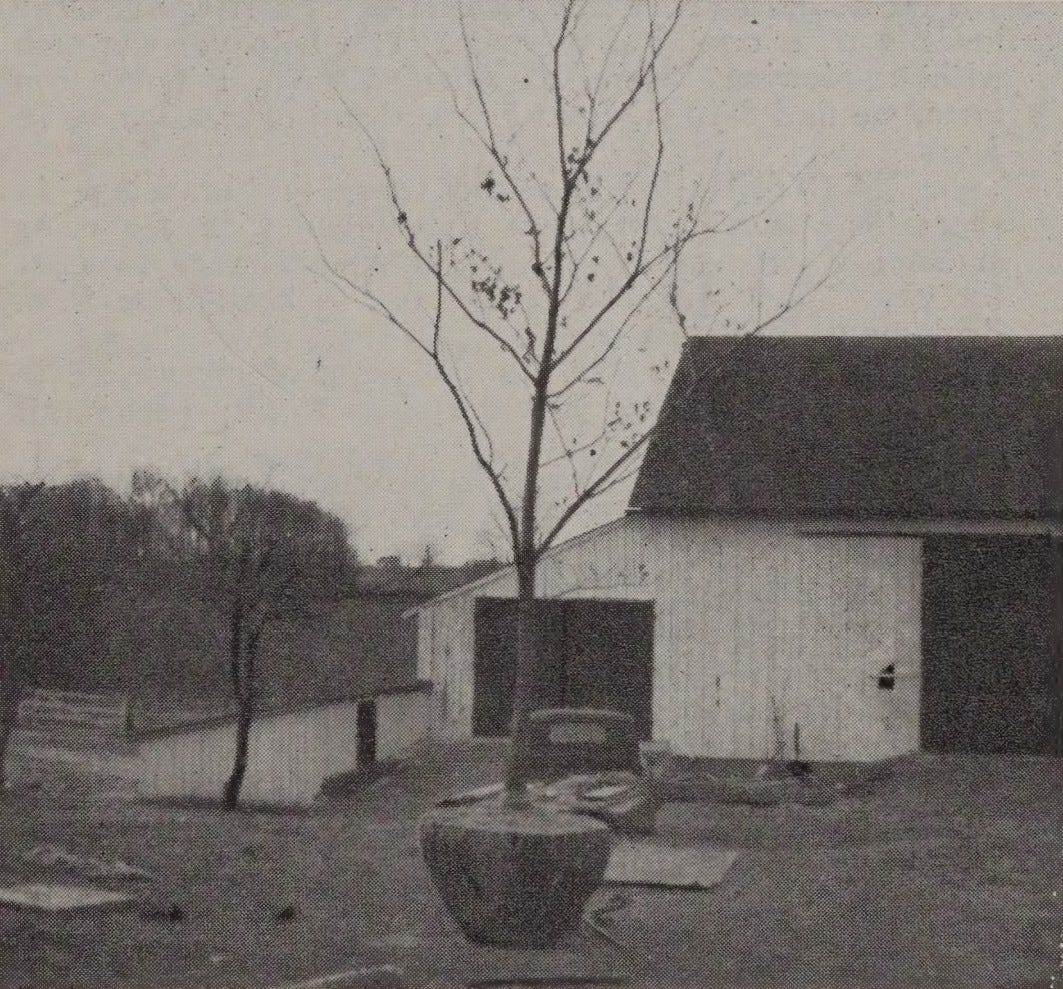
[Photo of a Chinese chestnut balled and burlapped, ready for shipping out of John Hershey’s Nut Tree Nurseries, circa 1956.]
Brian: Yeah I have heard of that.
Elizabeth: Well we have some trees down there but I can’t tell you what [?], but they bought some trees here [..].
Greg: So there's another possible place to look. See I …
Elizabeth: Now there may not be many there, but I just know that they bought them.
Brian: Uh huh.
Elizabeth: And uh. We used to go up through the [unintelligible] West Point, to an arboretum up there, but I can’t remember what we were going up there for.
Greg: Oh, to just let you see… this is from Australia, and this fella’s [Bill Mollison] gonna be coming to the United States who are sponsoring a tour that he’s giving, it’s an extension of the, of the p–, tree crops idea into, into perennial plants, and asparagus, and all of those things.
Elizabeth: Oh yeah, you know I have a friend in Texas and they are working on a Lespedeza, tree Lespedeza, something like that.
Greg: Or tree lucerne [Cytisus proliferus], that plant?
Elizabeth: No this is Lespedeza, I'm pretty sure, it’s a crop tree, you know.
Greg: Huh, a tree Lespedeza?
Brian: That sounds amazing.
Elizabeth: I just saw that the other day and I should have [..].
Greg: So these are young people, their ideas are definitely gaining, and uh…
Elizabeth: Well this boy in Texas, he’s, he’s, I don’t know what you’d call him, did you ever know some people they're so bright, they're almost nutty, you know what I mean? And yet he works and works, and can’t get any recognition with his work, you know, and once in awhile he’s written up in a magazine or so.
Brian: Huh.
Elizabeth: But he’s persistent, and he’s, he lives in maybe a one room shack, you know, and all this sort of thing.
Brian: Really?
Elizabeth: And uh, and we, he keeps in touch, you know.
Brian: What is his name?
Elizabeth: Bill Slick, William Slick [I found a Texas oil baron scion by the name of William Slick, who ran Pecan Valley Farms with his brother, but I doubt this is the guy Elizabeth refers to as he wouldn’t be living in a one room shack. If anyone finds out who please let me know.]
Greg: I've heard the name.
Elizabeth: Well he might be in some of John’s writing, I don’t know.
Brian: What part of Texas is he in?
Elizabeth: I sent him a note Christmas [unintelligible]. I had a file or such down here [?]. Well I would have to look it up for you! I think it’s El Paso though.
Greg: I think he’s a member of the Northern Nut Grower’s.
Brian: Maybe.
Elizabeth: Is he?
Greg: I think I've … maybe we can look in that old one that you have here.
Elizabeth: Well that’s pretty old.
Greg: Yeah.
End of first part, Beginning of second part (run time 25 mins)
Greg: Maybe Brian would have some things that he would want to ask.
Brian: You know what I was wondering is whether, whether John and you ever did much with actually feeding stuff to animals, persimmons, and honey locusts, and stuff.
Elizabeth: Oh sure, we had horses, and that… oh! If we wanted any persimmons, we had a grove of persimmons, you know, and several different kinds, I don’t know how many trees are there [..].
Brian: Did you run pigs under them?
Greg: [unintelligible]
Elizabeth: Oh the pigs and mulberries, mhm! And John liked mulberries too, ya know, we had very good mulberries. Oh their snouts would be all full of mulberries!
Brian: Ahaha!
Elizabeth: And if you wanted persimmon you had to get out early in the morning, the horses and cattle would clean them up, and the acorns, the cows would eat the acorns, ya know.
Brian: The cows would eat ‘em?
Elizabeth: Oh yeah! The honey locust too [?], that’s good feed.
Greg: Would anything eat the jujubes?
Elizabeth: We had those closed in, I don’t know about that.
Brian: Was…
Elizabeth: Except Kitty, hahaha. She loved em’! We had nice jujubes, ya know, nice thick ones!
Brian: Uh huh.
Elizabeth: Do you know the jujube [..]? Is there, is there, uh?
Greg: Well I've seen…
Brian: There’s a couple in there, yeah.
Elizabeth: They were all dried up, they called them dates, you know.
Greg: I've seen trees at the TVA, but I haven’t ever eaten them, you know.
Elizabeth: Oh they’re good! They really are, mhm.
Brian: Well, how far north will they grow, do you think?
Greg: They’re very hardy… one of the things that’s said about them is they need dry, they don’t do well in humid climate, but the [..] right there at Norris is a very humid place and they’re doing excellent.
Elizabeth: They’re right there by the river the [..], mhm.
Brian: Well do ya think that that kind of… the animals eating that stuff really supplemented a lot of their food?
Elizabeth: Oh sure! Oh yeah, you take pigs where they are mulberries and they didn’t eat much [?]! Aha.
Brian: Well I just wanna hear people, well hardly anyone’s ever done it.
Elizabeth: Oh yeah, that was part of our farm, that’s part of the whole thing, yeah.
Brian: So did you, did you sell beef, and uh, pigs and pork and?
Elizabeth: Yeah we use to have a butcher and sell them out, mhm, we had some organic growers, you know, from, maybe from Wilmington [Delaware], places like that, and buy our meat, mhm. Chickens.
Brian: Yeah! That’s … so you had like different pastures fenced out where these things, these trees were grown inside ‘em or along the rows or something like that?
Elizabeth: Well the pigs are fenced in of course, you can’t let them run loose ya know, of course all of our cattle, you couldn’t leave ‘em running around, you know, we had to keep the whole farm fenced in because of your neighbors, everyone did that [?], you know.
Brian: Right, what I mean, were there different lots, where you move things at different times, and stuff?
Greg: Rotations.
Elizabeth: Yeah, well, mhm, of course the horses and the cows had the run of the place because we wanted them to eat the stuff up, you know what I mean?
Greg: Were the fruit trees mainly planted along fence rows, or out in the field?
Elizabeth: No, we had an orchard [..], you know.
Greg: Yeah. I guess, pigs won’t eat pawpaws, you know about that?
Elizabeth: I don’t know, but I can’t eat them! Haha. One bite of pawpaw… I like them too! We had a nice planting [..] of them out there, not very many, we didn’t propagate them too much. But um, I get hives every time I eat them.
Brian: Oh yeah?
Elizabeth: Mhm.
Brian: They’re a little weird, aren’t they.
Elizabeth: Yeah but they’re good, I like them really, but they’re unusual
Brian: I like the first taste, yeah.
Greg: Well I just like them through and through.
Brian: Oh really?
Greg: Yeah, I can eat a lot of them and I like them.
Elizabeth: Oh I think they’re good for you, yeah, I think they’re great, they’re called the northern, Indiana banana, you know [?].
Brian: Yeah I know, haha.
Elizabeth: They get a little messy sometimes, but I still eat it [..]! Who sends me some pawpaws, [..].
Greg: Corwin Davis at Michigan? [Corwin D. Davis, 1910-2002. He was a pawpaw breeder in the north, of the upper midwest. Among his introductions was “Sunflower.”]
Elizabeth: No I believe Kitty’s brother-in-law, no wait, I know… Kitty’s brother-in-law, and she sends me, she brings me a bushel of oriental persimmons, you know, and I have a couple old women who like ‘em and we share them out. But anyway, she sends me pawpaws every once in awhile and a couple of these old women like pawpaws too, you know!
Brian: Oh yeah?
Elizabeth: Yeah, I was wondering I guess, it’s her brother-in-law’s, she, Kitty was planting, all her family, she had a stunted tree or something like that, she’d went [?] and planted it out and now they’re bearing and getting fruit of these things, you see?
Brian: Huh. So a lot of the kind of rejects from the nursery would end up over there.
Elizabeth: Yeah, and then we had… she took care of them, you know what I mean.
Brian: And they sprouted, yeah. Huh!
Elizabeth: It's funny thing they can’t get her interested in trees now, I think she had enough! Haha. She had to work so hard.
Brian: Yeah.
Elizabeth: Of course she’s married now, her first husband died, and she’s married again. She married a man, that had two boys, and now they’re married, and now they have a youngster, you know, and she’s, so, she’s having the best time, it’s the first time she really had time to enjoy, she came from a very big family and they really had tough [..], you know what I mean, and all that sort of thing. She’s such a wonderful person. But she, you can’t get her interested too much in trees, although somebody’s always asking her [..] whether she’d graft a tree for them.
Brian: Oh yeah?
Elizabeth: It’s just about two years ago she went to the mountains where they have a cabin, you know, they got together and everything, she has a cousin up around there, so she grafted a tree, or two or three of ‘em, mhm.
Brian: Did she really?
Greg: That sounds nice.
Brian: How ‘bout that! That’s great.
Greg: Did you graft?
Elizabeth: I never grafted a tree.
Greg: Oh, ok.
Elizabeth: I did most everything else, but I didn’t graft a tree.
Brian: You dug ‘em, but you didn’t graft ‘em.
Elizabeth: I didn’t dig them, anyway, I'm not a, you know… but I packed them! Oh, I packed trees! Big bundles like that, you know, oh man, man.
Brian: So how many orders, did you sell, like literally thousands of trees in a season?
Elizabeth: We didn't have that many, hahaha, we could never get ahead. You know it takes so long to do this, and you really can’t get help to do it!
Brian: Yeah.
Greg: So you were generally sold out on a lot of things?
Elizabeth: Yeah, some of them. Well that’s the way these boys are now, you know what I mean. Well you take Miles, I don’t know, how did you [..]?
Greg: He's a year behind on everything, but if you [..].
Elizabeth: Well, and there’s a fellow up there near him, [..] shack with [..], his wife died, and now his wife lost her mind, and she’s, and he had cancer for some while.
Greg: It's not George Weber [George Grover Weber, 1889-1978] is it, have you tried his [..]?
Elizabeth: No, he.. Ha! He died [unintelligible]... He had a little trouble with the [..] too.
Greg: All I know about him is that he had a nursery in…
Elizabeth: Yeah, he had, he was doing alright, you know, with the trees there.
Greg: Oriental persimmons and walnuts mainly.
Elizabeth: Well I hope he’s [unintelligible]... Oh about his nursery? He’s always sold ahead. And Miles, um, Nolt, he grafts a few trees you know, but you say he’s always sold out a year ahead. Get after him a year ahead if you want any trees, you see. Of course, he’s a farm, he’s a big farmer, you know what I mean.
Brian: Is he?
Elizabeth: And uh, yeah, this is just his hobby, you know, [..] he wants to play around, mhm.
Brian: Oh yeah, that’s neat.
Greg: I'd like to ask you something, I guess a little special. I've never seen a picture of John, do you have a picture of John [..]?
Elizabeth: Yeah, wait a minute. I think I have one out here [..]. [..] This is the way he looked when he went to Tennessee!
[*There is a pause while Greg and Brian look at the picture.]


[These three above are the only pictures of John I have been able to find, sadly maybe the only three which still exist. I’d love to know what photos Elizabeth showed Greg and Brian.]
Brian: Oh yeah.
Greg: In fact I'd never seen a picture of J. Russell Smith until very recently.
Elizabeth: Oh weren’t there any in his books?
Greg: No.
Elizabeth: This is with, well when Roosevelt was down there, you know, this is Roosevelt’s hobby [?] tree crops business.
Brian: Oh yeah?
Elizabeth: And he was down there.
Greg: Oh that’s great.
Brian: Yeah, really.
Greg: That’s wonderful.
Elizabeth: And here’s John, you see.
Brian: Yes.
Greg: Yes.
Elizabeth: And this Roosevelt’s person [?], I think that, uh, John’s boss was in there somewhere.
Greg: That is great, wow! There’s a quote in this…
Elizabeth: This was taken right then by the trees crops nursery, you know, right in front of the…
Greg: Yeah. On the cover of this it says, “This is wonderful! I think you’re doing a marvelous piece of work here” – President Roosevelt’s comment when he visited the crops nursery.
Elizabeth: Have you seen the McAllister nut, that long cross between hickory and pecan?
Brian: Yeah.
Greg: Yes.
Elizabeth: Well John had a couple of these to show him, haha, you know. And then the President was going to keep it, he said, “You can’t have that!,” John said [*Laughing, sighing.] [..]
Brian: Haha!
Greg: Oh that's great! That’s wonderful. Haha.
Elizabeth: But oh yeah, they were really sold on this. And I think, really J., Dr. J Russell Smith started the tree crop business, I think [..].
Greg: Well I've heard the other side of the story from the TVA, and now, they’re very disappointed because what happened is when John had to leave, foresters who didn’t know anything about fruit trees, took over, and it just went downhill. The only nut tree that they were interested in after that was the black walnut, because they could use the timber. And that’s all they really thought about. It was a really sad thing. Tom Zarger [Thomas G. Zarger, 1919-1994, held degrees in horticulture and forestry from Penn State and retired from the TVA in 1982 and also dig work in mine reclamation.] tried to bring in a diversity of things, but he just was not able to with his bosses, they had a strained r–
Elizabeth: Well I'll tell ya, John had a hard time down there, ha, course he was aggressive, mhm. But he would’ve never gotten ahead in the nut tree business, if he weren’t, so, haha, you need to be a little aggressive.
Greg: I understand, yeah.
Elizabeth: I mean you really have to have some, [..] that get up and go, you know what I mean?
Greg: Well I, in all modesty, and seriousness, I think that the time has finally come for tree crops to really take hold. There are so many people, we have about 200 subscribers to our journal now.
Elizabeth: Oh that’s great.
Greg: And there’s just such an interest, well, on my way back home I'm going to be stopping in West Virginia. And there’s a professor at West Virginia University in Morgantown who is a forester, and yet he’s interested in tree crops sufficiently to have me come and give a class to the farm forestry class, so I'm going to talk about tree crops.
Elizabeth: Well they’re teaching it in schools now, you know. Dr. Smith who wrote geographies you know [..] used to use ‘em, and I think in some of those, you know, mention something in there.
Greg: He always tried to mention tree crops somewhere, yeah.
Elizabeth: There was a doctor down in West Virginia that had planted a lot of trees, and it was way up, you know they said that if West Virginia would be straightened out it would be the biggest state in the region.
Brian: Haha!
Elizabeth: But oh we went up hills, I tell ya, this doctor had, I can’t remember [..] I can’t remember…
Greg: I don’t know either.
Elizabeth: See what we can find in here.
Brian: That’s pretty good.
Elizabeth: Well, I don’t see it here so…
Greg: Did you ever, do you know of any correspondence, or trees sent to Antioch College in Yellow Springs, Ohio, and Arthur Morgan who was [..]?
Elizabeth: Yes. Yeah I know it was their school out there, look, I don’t know what they did out there, I can’t remember, but Antioch, yeah, I think maybe John was there, I’m not sure, but I believe he had some correspondence there [..].
Greg: I grew up in Dayton, Ohio, real close by there and then going through back through the literature I just recently found that there was a guy who did work on nut trees and planted a grove of nut trees in Glen Helen, which was an area that Arthur Morgan saved from development, he saved from a total deforestation by, I think he actually had to lie about certain things, he told them that if they did something it would mess up the Yellow Springs water system, when it really wouldn’t, and that’s how he saved this land. And on that land they’ve planted a nut grove, but I've never seen it and I'm gonna have to go back and see what happened to it. [This would be a great field trip for someone!]
Elizabeth: [unintelligible]
Greg: In Yellow Springs, Ohio, it’s about…
Elizabeth: Oh yeah, there’s in Yellow Springs…
Greg: It’s about, it’s in, near Xenia, Ohio, it’s west of Dayton, around it.
Elizabeth: Oh yeah, this place I was telling you about, at New York, you know, this biodynamic place that’s…
Brian: That's at Spring Valley?
Elizabeth: Yes, Spring Valley, that’s what, I was getting mixed up there. Did you ever hear of Dr. Stokes? Mr. Stokes… [H. F. Stoke of Virginia, probably Harvey F. Stoke 1878-1977]
Greg: Yeah in fact I have some old annual reports that he owned, and then they were turned back over to the [NNGA] and they sold them, yeah.
Elizabeth: Turned over to what?
Greg: To the Northern Nut Growers for sale, they still sell the old back issues. They request that the members if they don’t want them anymore, give them back so that they can sell them to other people who may be interested, recycle them…
Brian: It makes a lot of sense, that’s for sure.
Elizabeth: Well, they didn’t get a great [?] money for their time, you know, and [..]
Greg: Do you know the name Ralph Kreider from Illinois?
Elizabeth: Yeah.
Greg: He's a real good friend of mine now, he’s about 60. He’s a tenant farmer, and…
Elizabeth: Oh really?
Greg: And he got Tree Crops the book in 1941 in Decatur, Illinois public library, he bought the book after reading it, read every year for 15 years, he told me.
Elizabeth: Oh you don’t mean that!
Greg: I'm serious!
Elizabeth: Some people read the Bible every year [..].
Greg: He read it from cover to cover every year, and he has, he got his first trees in 1942 after reading Tree Crops, and he’s been collecting nut trees, minor fruits, he’s got 15 varieties of persimmon, and this, he’s a…
Elizabeth: Fifteen!?
Greg: American persimmon. He’s doing all this on rented land, he’s a tenant farmer.
Elizabeth: Oh isn’t that wonderful.
Greg: It’s amazing, he’s, well he’s…
Elizabeth: Just so they don’t come down when he leaves.
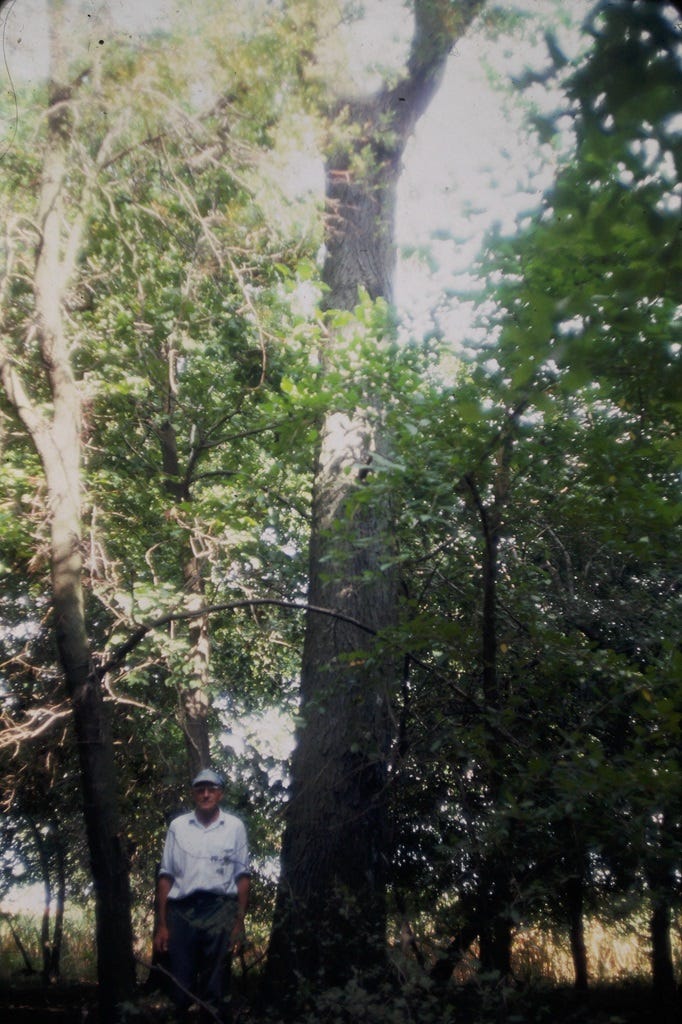
[Ralph Jacob Kreider, Jr., 1920-2015
Ralph is one of the unsung heroes of the tree crops movement. He was an active fruit and nut explorer who found and introduced many varieties. He was an active planter and breeder, and not being constrained by private land ownership for himself, he was freed to plant everywhere.
His introductions included Pipher, an American persimmon from central Illinois, which is the seed parent of Prok persimmon (Prok = Persimmon Ralph Kreider). Ralph did a lot with oaks too, and introduced several varieties which have been carried on through Ken Asmus of Oikos Tree Crops, among others. In the picture here, he is pictured with a bur oak (photo credit Greg Williams). He grew out and shared honey locusts as well, and all kinds of other fruit and nut tree crops materials he would find.
He served as secretary of the Illinois Nut Grower’s Association for many years, and was involved with NAFEX (North American Fruit Explorers). He left a deep impression on those who were his friends.]
Greg: He’s taken it farther than any other person besides yourself. He actually planted seed every year from his Millwood honey locust, and now he has hundreds of feet of, in the fence rows, of seedling trees, many of which are bearing real well, and so, now we’re going to gather seed next week.
Elizabeth: Did he do any grafting?
Greg: Oh yeah, he’s a really good grafter
Elizabeth: Oh yeah that’s wonderful.
Greg: But he doesn’t sell anything it’s just for his farm, he keeps sheep and cattle, and he feeds the sheep honey locusts.
Elizabeth: Well I was gonna say, don’t they eat it? Sure! That’s what I'd feed to ‘em.
Greg: Yeah. But the wonderful thing is he has all these trees and we’re gonna be collecting the seed, and sending it to India, for use over there for livestock feed, the honey locust.
Elizabeth: Oh my! That’s great.
Greg: I think it’s really wonderful.
Brian: It is.
Elizabeth: There’s a lot of possibilities out there if you have enough money to work from.
Greg: Well, I just got a grant.
Elizabeth: Is this… I was just gonna say, is this some sort of a foundation or something? I didn’t…
Greg: Well, we were given money by Lawrence Hills, who’s ah, I'll bring you a brochure when we go out, our newest brochure… Lawrence Hills [Lawrence Donegan Hills, 1911-1991], who is the head of an organic gardening group in England, gave us the original money, and now we’ve been going out to private foundations to try to get some money, but what I've done, just last week I found that I got a grant from the Department of Energy, to do work on tree crops. I was really surprised.
Elizabeth: How did you go about getting it?
Greg: Well it was in a thing called the Appropriate Technologies Small Grants Program, these were grants less than $10,000, so I got a grant of about $4000.
Elizabeth: Do you have to be sponsored for this, and all that sort of thing?
Greg: Well, no, I just wrote up a proposal, and…
Elizabeth: I mean… oh!
Greg: And our group is a tax-exempt non-profit organization, so you needed to be, and, well you could have been an individual for this particular program, but, I was real lucky, I think there were 92 applicants in Kentucky and they had, I think they gave out about 4 or 5…
Elizabeth: And you were one of them?
Greg: Yeah.
Elizabeth: oh that’s great
Greg: I'm real happy.
Elizabeth: Who's with you, who’s in with you, this thing?
Greg: Well…
Elizabeth: What's your first name?
Brian: Brian.
Elizabeth: Brian.
Greg: Well, we have a California office, and this fellow named Miles Merwin who does the work out there, and it’s just me, we are homesteaders, we live on a 70 acre hill farm in Kentucky.
Elizabeth: Oh really? Oh, wonderful.
Greg: And my wife and I, we just had a new little son in September.
Elizabeth: Oh great, great.
Greg: I miss him a lot, right now, ha!
Elizabeth: Oh yeah, yeah, you have to be [..] Are you thinking now, that you have an option on this farm down at the [..]?
Greg: Yeah, we own our farm outright in Kentucky, and now we’re thinking about…
Elizabeth: Now you’re thinking about West Virginia?
Greg: We’re thinking about moving to Virginia [..], and starting maybe a non-profit tree crops nursery [Greg Williams and his wife Pat considered taking over J. Russell Smith’s old Sunny Ridge nursery in the ‘80s]
Elizabeth: Well you should have something to work from there, aren’t the trees standing there yet?
Greg: Yeah, we’ve got a lot of, too many, trees, and…
Elizabeth: Are they gonna sell the house too?
Greg: Well, the houses have already been sold.
Elizabeth: Oh they have.
Greg: There's one house called the Hollow House that we might be able to buy, and it’s an old log cabin that we could live in, but we may have to build a new house.
Elizabeth: Mhm.
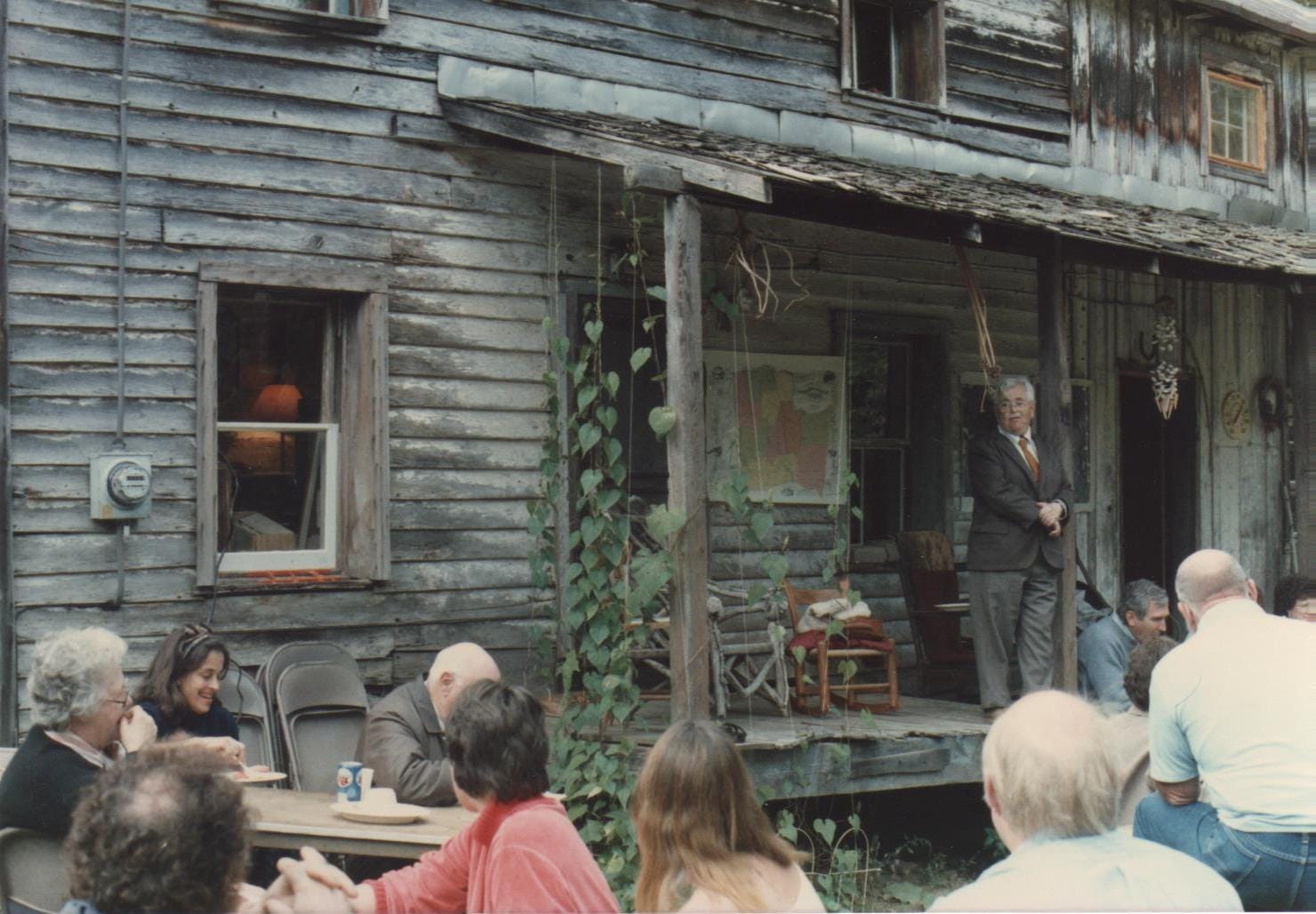
[Pictured here is J. Russell Smith’s son Dr. Newlin Smith on the porch of the Hollow House, giving a speech about history. The Hollow House was a log cabin and the home of Bill and Linnie Wiley lived. Bill Wiley was J. Russell Smith’s right-hand man in the Sunny Ridge Nursery.
Photo shared by Joanne Marcus Britcher on findagrave.com]
Greg: They, the place where his uh, the Wiley’s, his grafters lived has been bought by some more young people, similar to us, some homesteaders, and they’ve got chickens, and…
Elizabeth: Oh yeah!
Greg: But they’re not particularly interested in fruit and nut trees, I think that might change.
Elizabeth: Haha!
Brian: They have them all over their yard too, they’ve got persimmons…
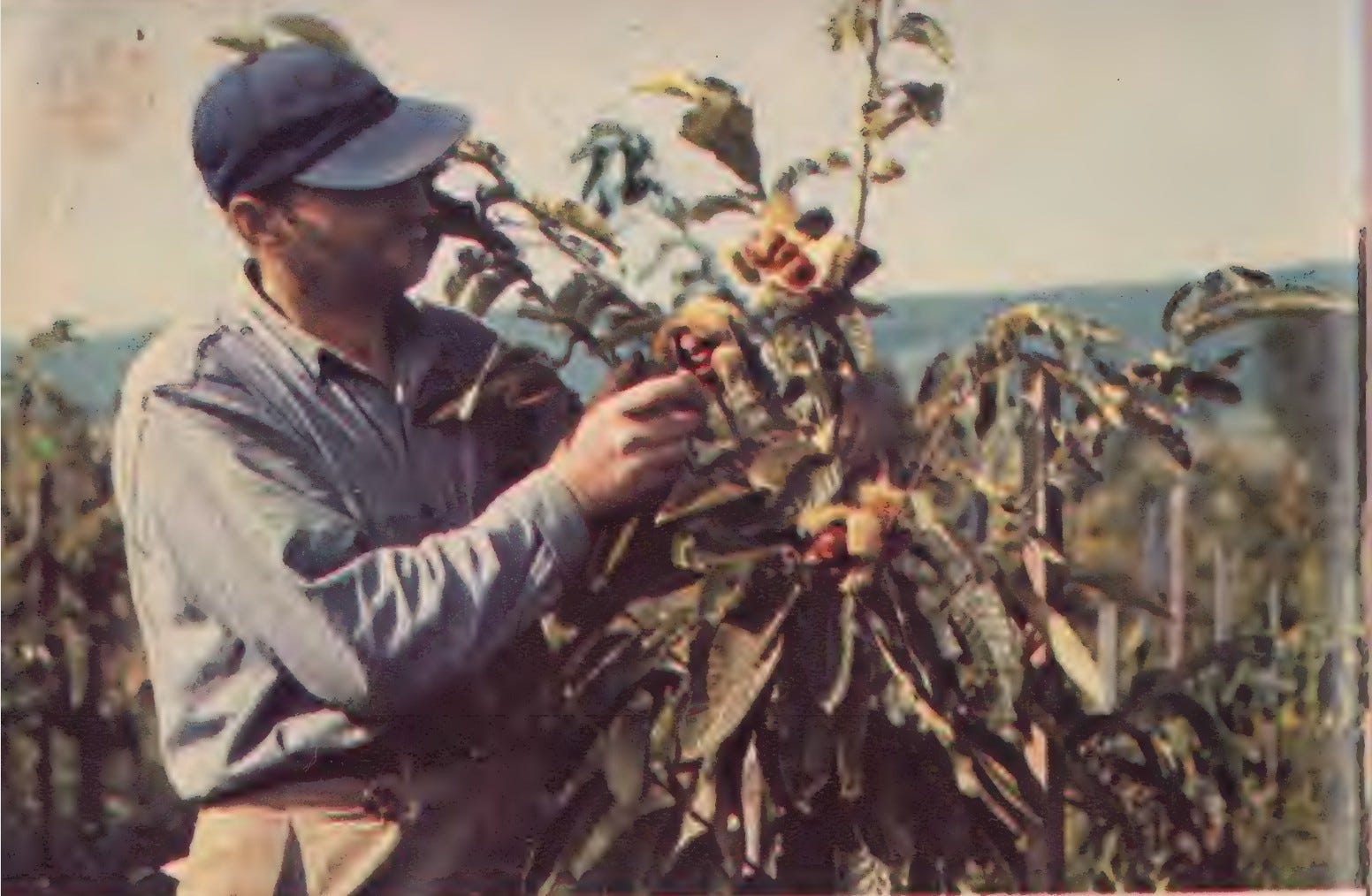
[John William “Bill” Wiley 1897-1984
Bill was J. Russell Smith’s right-hand man in the nursery. Bill was his grafter and would propagate thousands of grafted trees per year.
A recording of Bill surrounded by his family and members of Smith’s family and detailing his recollections of the nursery was made for the memories of his children in 1980. I plan to make a transcription for that interview too at some point and give it the same treatment I have for this one here.
Picture of Bill Wiley from Ford Times Magazine, March 1951]
Greg: And they have honey locusts, we collected scionwood from them, from their honey locusts, it’s probably…
Elizabeth: [..] were they marked [..]?
Greg: It’s probably a Millwood, I can tell…
Elizabeth: Well I was gonna say, if [..]
Greg: …by the taste of the pods, and by the shape of the pods, and by the tree
Elizabeth: Oh you go around tasting things here.
Brian: Hahaha.
Greg: Oh sure.
Elizabeth: Ah! I was wondering what else we had down there… Well, did you get down to bird feeding, example?
Greg: Well I have a pamphlet about wildlife feeding, in general, but not particular on bird feeding.
Elizabeth: [unintelligible] Kitty and I have some of those. I'm in the process, I was gonna say, we have a lot of things packed in the cellar, and I'm going through some of those things, I might find some more.
Greg: If you find anything, we would be happy to buy it, or just have it.
Elizabeth: Well I would like to give it to you.
Greg: And we’ll certainly preserve it for the future…
Elizabeth: Oh I understand that, it’s why I offered.
Greg: …in a library situation. Our library’s open to the public and we’re real careful, we send abstracts to Paris, France, of everything that we have, so it’s pretty…
Brian: Really?
Greg: Yeah, to the International Federation of Organic Agriculture [
https://www.ifoam.bio/
].
Elizabeth: Let's see, we sent trees to Russia one time, and we sent one to, um… Jefferson’s place, did Jefferson have a place [..]?
Brian: Monticello?
Greg: Monticello?
Brian: In Virginia?
Elizabeth: No… across, don’t know who’s place was [..]. We sent trees, well we sent some to France, oh right after [..].
Greg: Well I tell you, that I'm sending scionwood this spring to New Zealand.
Elizabeth: Well I tell ya, the way we had to pack those trees to go to Russia, I'll never forget, we had to take them down to Philadelphia, ya know, and have them crated, and all… I'll tell you, it was something!
Greg: I just sent this Notes on Honey Locust, this thing. Cost us $22 to send it to New Zealand, but they’ve never seen this before, and they’re starting tree crops nurseries over there now.
Elizabeth: Oh well that’s great.
Greg: It's really exciting! So I'm sending scionwood from some of the selections that John made down in Tennessee.
Elizabeth: How do you do all this if you don’t have help?
Greg: Well, my wife and I work, I was trained as a mechanical engineer, and my wife was trained in computer science, and so we’ve worked for many years to build up a savings, to move to the land.
Elizabeth: Good, good, mhm.
Greg: We weren’t rich to begin with but we’ve lived pretty frugally.
Elizabeth: It's too bad you weren’t, because you… haha! Because there’s some money [..]!
Greg: Now I understand Miles Merwin [Miles founded the International Tree Crops Institute (ITCI), under which Greg Williams ran the Appalachian Regional Office out of Kentucky. Miles is still alive, and operates Ridgeback Tree Farm near Portland, Oregon.], he’s out in California, he is pretty rich, so there, uh, that helps.
Elizabeth: Hahahaha! Yeah, he’ll help it along, will he!
Greg: Yeah, he’ll help.
Brian: Oh yeah.
Greg: But ah, no, we just, I guess you talked about vision before, and I, the way I got into it was in 1977, before we moved to Kentucky, our neighbors…
Elizabeth: You mean that’s all already in it, you’ve done all this work already?
Greg: Yes, it’s been…
Elizabeth: Oh boy, you’re a go-getter too! Isn’t that wonderful!
Brian: Hahaha.
Elizabeth: Oh, then he’s doing wonderful.
Greg: Well, I tried. A neighbor suggested that I read Tree Crops, he thought it made real good sense on our land, and we live in a very hilly area, and I read it, and I had written a paper for a conference at which Robert Rodale was going to be, so we got together, our neighbors and I, and wrote a proposal to do research to try to get some money from the Rodale people. Well, we came up here in the middle of a blizzard in ‘78, February of ‘78, and uh, they didn’t have any money for us, but they were real helpful, and we got to meet people at the USDA, who are, there’s one fellow who’s working on honey locust down there
Elizabeth: Oh that’s good, I'm glad to see they’ve made a little progress!
Greg: Yeah, there’s a little progress!
Brian: Well he’s the guy that’s able to get money to send the seed of honey locust to India.
Elizabeth: Oh that’s great.
Brian: So that’s really neat.
Greg: Really nice.
Elizabeth: Yeah, well it helps getting people on, on a basis where they understand each other, you know. You know if they understand each other, and all. Trees are a good way to get them together! Haha.
Brian: Yeah.
Greg: So at any rate, now I uh, well I have to put out a journal edition when I get back, we have a journal and I answer probably five letters a day there from people who’ve gotten publicity in the Organic Gardening, and in Mother Earth News, I don’t know if you’ve ever seen that, but…
Elizabeth: I've heard of it, yeah, but I haven’t seen it.
Greg: And a few other small farming journals, and so there’s a lot of young people getting interested.
Elizabeth: Oh this is great, ya know, this is wonderful.
Greg: It’s great…
Elizabeth: But we need to have these trees planted. You know in Germany when they cut so many trees down, they planted so many!
Brian: Did they?
Elizabeth: And I think they’re doing that in the United States now, you know. They just slaughtered the trees down, many kinds, didn’t put them back!
Greg: For sure.
Elizabeth: Oh and of course if people are gonna buy these barns, er, these farms up and put houses on them, and all that sort of thing, it’s gonna be terrible!
Brian: It’s what they’re doing.
Elizabeth: And now we’re taking all these, boat people, and people like them, we’ve got to give them places to live.
Brian: Yeah.
Elizabeth: And um. I mean our population is growing so much that they’re gonna spread out and have apartment houses and all sorts of houses, it takes more land!
Brian: Mhm.
Greg: One of the most important things about tree crops is they can be put on land which is not suited to row crop farming, in fact that’s the whole point, we can expand our utilization of land…
Elizabeth: Well that’s one thing, Fasel did leave some trees around the places he butchered, you know.
Brian: Yeah.
Greg: I hope he left the right trees! I hope he left some honey locusts…
Elizabeth: How was it, how was it? John Henry said that uh, well, one of the forester’s have a friend that moved on Fasel’s place, in one of the houses, and he seemed to have a little access to some of the things in the nursery, John Henry was hoping to work with him maybe a little bit to get some things, plus it’s a shame that there’s valuable…
Brian: So Fasel keeps a pretty tight group on everything there? He really…
Elizabeth: Yeah, it’s funny, I don’t know why, they just don’t want company.
Greg: Well I'm sure they don’t want people to come in and wreck trees, and things like that, so, I can understand.
Elizabeth: Well he never seemed to let me on [?], that house, you know, I don’t care what they did with it, it was a nice big old stone house, about 20 inches wide stone, you know. It was a big old thing, and not big, but I mean it was built like a Ford. I go down there, I don’t mind at all, all the other things, we have to build a new barn, our barn burned down there after we moved.
Greg: I heard about that.
Elizabeth: But let me go out to the trees, I’d sure love seeing it [?].
Brian: Yeah.
Elizabeth: When John cut a graft, you knew the thing was alive, you know what I mean. He was so gentle, nobody ever did a graft like John, my, John, you know what I mean.
Greg: He was really gentle on things.
Elizabeth: Yeah he was, mhm, you could tell he, he had something.
Greg: A lot of respect for living things.
Elizabeth: ‘Course his dad was interested in trees too, they were Amish [?] Mennonites, they were Mennonites, you know what the Mennonites are?
Brian: Yeah. Well how is he related to the Hershey of Hershey’s chocolate?
Elizabeth: Well not very far back, I mean pretty far back. They’re all one family, I think, but they’re way back. We have a Hershey book, it’s a whole book on Hershey! Ha.
Brian: Oh yeah?
Elizabeth: And uh, I noticed how they don’t claim any distinction in that respect, ahahaha!
Greg: Right.
Elizabeth: But I like Hershey kisses!
Greg: There’s a lot of Hershey’s in the area, I'm sure.
Brian: I guess so!
Elizabeth: Oh yeah the place of full of Hersheys! What was it, one pike down there, came from what they call The Gap to Strasburg, and it’s about 10 or 12 – oh yeah, more than that – miles, maybe. Anyway, I think all the Hershey’s lived there except a couple neighbors, they were all Hersheys in there! Haha.
Brian: Uh huh. The Hershey road, huh?
Elizabeth: It was the Strasburg road but there were a lot of Hersheys there. I was just wondering whether there was anything else I missed about telling you about, John Henry may think about, John Henry stayed with us several summers, you know, down in Tennessee, just when he was a kid.
Brian: Oh yeah?
Elizabeth: That’s how he got to be a forester, I think, he got interested in trees.
Brian: I can see that!
Elizabeth: He was, he knew about Tom Zarger, he said he went to school with Tom. Tom Zarger’s still at TVA, and there was another guy…
Elizabeth: Oh did he, I didn’t know.
Greg: There was another guy there, there’s a guy named Kline [Henry Blue Kline, 1905-1951, known as a member of the Southern Agrarians], who’s after John.
Elizabeth: Oh yeah, sure! Uh huh!
Greg: And then Tom Zarger came.
Elizabeth: Well Kline was there when we left, he was in the forestry division.
Greg: Yeah. Well I think he more or less took over when you left, and then Tom Zarger took over from him.
Elizabeth: Harnish [?] is he a local boy from Tennessee?
Greg: Kline?
Elizabeth: No, ah…
Greg: Zarger?
Elizabeth: Oh Zarger, yeah.
Greg: I don’t know where he’s from.
Elizabeth: I thought you were saying Harnish [?].
Greg: No Zarger, Tom Zarger.
Elizabeth: Yeah I remember that name, sure. Mhm.
Brian: Well is it, we’re supposed to meet at noon?
Greg: Ah yeah, around noon we should be there.
Elizabeth: Did he tell you how to get there?
Greg: He told me how to get there, once we get onto the road that heads towards the turnpike, 222 I think, or 227…
Elizabeth: Yeah I'm trying to think how you can get on there, take the [..] the right direction!
Greg: We could look at our map while we figure it out.
Brian: Yeah, I'm sure we could…
Greg: Well, maybe I should just turn this off here.